






















Government Calls for Export-Focused Medical Device Manufacturing
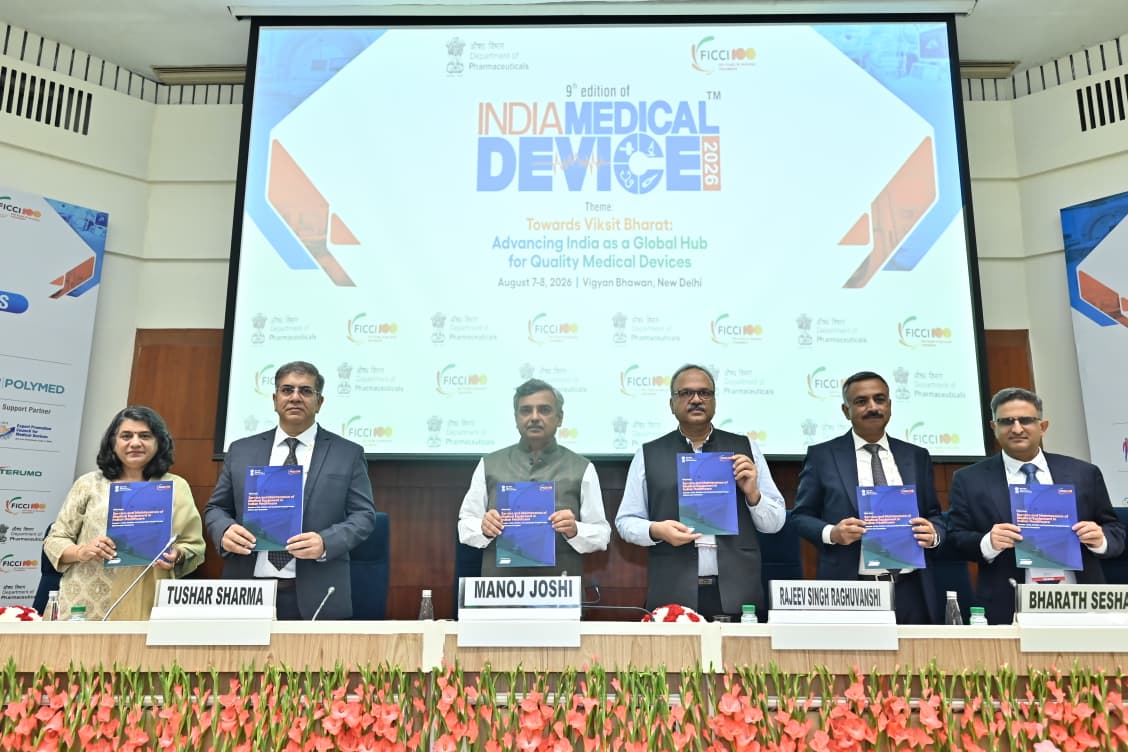
The 9th edition of India Medical Device 2026 began at Vigyan Bhawan, New Delhi, bringing together policymakers, regulators, industry leaders, innovators and other stakeholders to strengthen India’s medical devices sector.
Organised by the Department of Pharmaceuticals, Ministry of Chemicals & Fertilizers, in association with FICCI, the two-day conference focuses on ‘Towards Viksit Bharat: Advancing India as a Global Hub for Quality Medical Devices’.
Addressing the inaugural session, Manoj Joshi, Secretary, Department of Pharmaceuticals, said India must build a globally competitive and export-oriented medical device industry. He noted that domestic manufacturing can create jobs, strengthen capabilities and improve supply-chain resilience during global disruptions.
Joshi highlighted India’s progress in consumables, disposables and the assembly of advanced equipment, including diagnostic and imaging systems. However, he stressed the need to increase domestic value addition, expand component manufacturing, promote advanced medical technology and strengthen quality standards.
India Must Move Beyond Import Substitution
India’s medical device market is currently valued at around $16 billion, compared with a global market of more than $600 billion. Therefore, Joshi called for greater integration with global value chains, easier movement of components and products, and stronger collaboration between startups and established companies.
“India must move beyond import substitution and build an export-oriented industry that serves global markets,” he said.
As per the press release, Drugs Controller General of India Dr Rajeev Singh Raghuvanshi said the sector is shifting from an import-driven market towards a domestic manufacturing-led ecosystem. He called for stronger capabilities in high-end Class C and Class D medical devices and in-vitro diagnostics, along with faster and more predictable regulatory approvals.
Industry Highlights Investments and Innovation
Tushar Sharma, Chair, FICCI Medical Devices Committee and Managing Director & GM, India & South Asia, Abbott Healthcare, said companies are expanding investments in R&D centres, manufacturing, engineering, clinical research, software, service networks and workforce development. These investments, he noted, are creating skilled jobs and strengthening India’s MedTech capabilities.
Meanwhile, Jyoti Vij, Director General, FICCI, said the sector’s next phase of growth will depend on innovation, R&D, resilient supply chains, advanced manufacturing, globally aligned quality standards, digital technologies and stronger international market access.
Bharath Sesha, Co-Chair, FICCI Medical Devices Committee and MD, Philips Indian Subcontinent, said the discussions highlighted India’s strong potential to emerge as a global medical devices leader.
White Paper Calls for Stronger Equipment Maintenance
A key highlight of the opening day was the launch of the white paper ‘Strengthening of Service and Maintenance of Medical Equipment in India.’ The paper calls for a stronger and sustainable service and maintenance ecosystem to improve the safety, reliability, lifespan and uninterrupted performance of medical equipment across the country.