













Beginning of A Long Journey
A young boy from Nagpur with hardly any money in his pocket rose to become one of India’s pioneering cardiac surgeons. Dr Devendra Saksena’s life is a journey of purpose, precision and faith. Trained at Henry Ford Hospital, Detroit and celebrated for shaping the course of Modern Heart Surgery in India, his story goes beyond medical milestones. It is a reflection on endurance — the long nights in the operation theatre, the quiet prayers before a critical mission and the countless moments when courage and compassion met at the edge of life and death. He was not merely a surgeon, but a teacher, a man of faith and a lifelong student of humanity. He believed not only in healing the body but the spirit. He believed in the enduring truth that while medicine can repair a heart, it is faith and courage that keeps it beating.
No wonder his autobiography “Open Heart Destiny” has the punch line “Guided by Science, Anchored in Faith.” And he calls it “An autobiography of science and faith.” This autobiography is like a running commentary on his life’s journey, on his life and times, that is so inspirational.
The autobiography is written in a unique style, eminently readable, in short staccato sentences, a compilation of brief paras, episodic, interspersed and well-illustrated with pictures. It’s totally different compared to many other autobiographies. No lengthy expatiations. All brief, to the point description of the episodes or events from the beginning that takes you “through lecture halls and operating theatres, through nights of restless decisions and days of unexpected revelations.”
Where Science Meets Spirituality
Structured across 14 chapters, the book opens with a compelling first chapter titled “God’s Plan,” exploring how science and spirituality intersect in healthcare.
Despite the advances in modern medicine, Dr. Saksena emphasizes that faith often plays a crucial role when nothing else seems to work. The narrative consistently highlights moments where science and spirituality converge — especially in the most critical situations.
The other chapters take the reader through all the important phases of his life, both in India and overseas, the varied experiences he had with doctors, medical professionals, students and patients right through to his family and friends.
A Global Healing Journey
From the United States to India, South Africa to Mauritius, the book traverses geographies and experiences. Through these, he reflects on what it truly means to heal:
“I learnt that to heal is not always to cure, sometimes it is simply to hold another’s suffering as gently as you can.”
Right through, he emphasises the higher power that guides a surgeon’s hands. He recounts many medical emergencies brought in hopeless cases, but purely by dint of belief that the person can be saved and working through marathon procedures, hours of microsurgery and guidance through intuition, training as he says “divine intervention,” patients are saved. But there are failures too, when despite the best of efforts, a patient dies, leading to emotional distress.
Over the last 50 years, Dr Saksena has performed over 28000 heart surgeries in the USA, India, Mauritius, Tanzania, Myanmar, Kenya and Oman and over 50% of them have been free of cost. He has played a stellar role not only as a cardiac surgeon but also in building medical institutions, professional training and development and starting charitable trusts for medical treatment for the poor, the needy and for underserved areas.
Dr Saksena talks of his life at Henry Ford Hospital in Detroit, USA. He says that the US was a totally different experience from India. “My first week at Henry Ford Hospital felt like being onto a different planet. The machines beeped differently, the lingo was faster and the hierarchy stricter. But I watched. I listened. I learned. The nurses had an almost sixth sense for patient changes. Everything was precise, choreographed and unforgiving of error.”
Throughout in his book, not only does he lavish praise on his mentors, professors and other doctor colleagues but also nurses and other medical assistants, perfusionists, anaesthetics. He says “I learned to listen to ICU nurses, especially when no monitor could detect what they sensed, a subtle shift in breathing, a pattern, a delay in response. Time and again they have saved patients by noticing what we didn’t. I learned from the nurses that medicine is not only about knowing. It’s about noticing.”
Return to India: Purpose Over Comfort
Back to India in 1970 after his long stint in the US, he felt like it was a new beginning with less structured systems and scarce resources. Though the need for surgical care in India was immense.
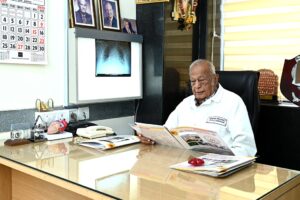
Heeding the late Indian Prime Minister Indira Gandhi’s call for expatriate professionals to return to India, he responded without hesitation. He got appointed as consultant surgeon at Bombay Hospital. But the Indian system with insecurities built in, continued with looking at accomplished experts with suspicion particularly if they were foreign returned. Many things moved slowly at their own pace or deliberately.
He helped establish cardiac surgery units at St George Hospital in Mumbai, at SMS medical college in Jaipur and at the Super Speciality Heart Centre in Nagpur. He realised that advanced healthcare was beyond the reach of the poor. He writes “From the start, I refused to allow private sector practice to sever me from those who could not afford it. More than half my surgeries were done free of professional charge. But charity on an individual scale could only go so far. I wanted an organised mechanism to meet the scale of need I saw daily. I founded the Bombay Medical Aid Foundation in 1979 with a modest Rs 10,000 donation. At first, it was a small initiative. Over the decades it grew into a major philanthropic force, raising more than Rs 8 crores and assisting thousands of patients in need of surgery in heart disease, cancer and other serious conditions. We expanded beyond cardiac care, supporting a charitable hospital in Vasai on the outskirts of Mumbai, serving the tribal population with free surgeries, dialysis etc. It was a living lesson I hope my students would carry with them — that surgical experience is only half the story and our responsibility extends to the social architecture that determines who can access care.”
Awards and Recognitions
Many accolades and awards have poured on him. Just to mention a few: Pfizer Humanitarian Award from the American College of Surgeons, which college also inducted him as Master Surgeon; Lifetime Achievement awards from the Indian Association of Cardiac Thoracic Surgeons, the Paediatric Cardiac Society of India and the Society of Minimally Invasive Cardiovascular and Thoracic Surgeons of India. The President of Mauritius conferred upon him the rank of Commander of the Order of the Star and Key of the Indian Ocean (CSK). President Abdul Kalam had conferred on him the honorary rank of Surgeon Commodore in the Indian Navy.
In Mauritius
Later his work took him to Mauritius at the request from Swami Krishnananda, who made the Mauritius government invite him there. He speaks of the challenges there and in other countries which were all country specific. Limited infrastructure was a challenge in developing countries.
The Mauritius President has written the foreword to his autobiography, where he praises Dr Saksena’s work of addressing the nation’s unmet medical needs as his personal mission. He further states in his foreword, “Dr Saksena’s legacy is not confined to accolades alone. Rather, of lives, quite literally in the hearts of innumerable patients, who got a second chance to live.”
His experiences in Mauritius and elsewhere, though involved challenges: language barrier, shortage of equipment, bureaucratic delays etc, taught him that medicine is not just about science or technology but about showing up, when needed, even where the settings were imperfect.
Human Side of Healthcare
He also narrates the life changing experiences he had with recovered patients and their families, their prayers, their worries before and the smiles after a surgery. This also needs emotional equanimity, he advises. What to say to a mother, who asks if her child would live or die. Or when a father clutches the surgeon’s hand after a successful surgery. These, one doesn’t learn in the curriculum. Then there are ethical dilemmas one faces, when faced with a patient whose repair is doubtful with little chance of survival. Should we proceed, or shouldn’t we? He advises, “You can learn to repair hearts, you must also learn to keep your own from hardening. For me, this meant finding moments of detachment without indifference — walking through the hospital garden before morning rounds, reading poetry late at night, listening to the unhurried voices of friends not connected to medicine.”
Narrating on the 24×7 life of a doctor he talks of how demanding the medical profession can be.
“You will miss birthdays, anniversaries, milestones. You will learn to live with interrupted meals, with plans that dissolve at the sound of a phone. But you will also have moments that no other profession could offer — the quiet relief of a patient who wakes from surgery with colour back in their cheeks, the hug from a family who had been bracing for loss. If you can find enough of these moments to keep your spirit fed, you will endure.”
And also how much a doctor would miss quality time with one’s family— one’s parents, spouse and children.
Wisdom for the Next Generation
He has many wise advises to young doctors:
“To young doctors who may be reading this: your training will teach you anatomy, physiology, pathology, pharmacology— the grammar of medicine. But your sentences, the way you put that knowledge together, will be your own. You will as I did, find yourself standing in front of a decision no textbook has prepared you for. And in that moment, you will draw not just on the lectures you attended, but on the person you are — your sense of responsibility; your tolerance for risk, your capacity for empathy. These things cannot be examined in an exam hall, but they will be examined in life, again and again.”
He urges medical students to ‘fiercely’ cultivate two very important attributes as much as surgical skills: Curiosity and Humility. Curiosity to help in much needed continuous learning and humility to keep arrogance away, particularly when one becomes more and more accomplished.
Conclusion: A Legacy of Heart and Humanity
Open Heart Destiny is far more than an autobiography — it is a testament to a life lived in service of others. It blends science with spirituality, skill with compassion, and achievement with humility.
Dr. Devendra Saksena’s story reminds us that true healing lies not just in technical excellence, but in empathy, faith, and an unwavering commitment to humanity.
For doctors, it is a guide. For students, an inspiration. And for every reader, a powerful reminder that while medicine may save lives, it is the human spirit that gives those lives meaning.
Note: For availability and any enquires regarding the book, you may contact bombaymedical1979@gmail.com