














Abstract
Autoinflammatory diseases are a group of disorders caused by a dysfunctional innate immune system. They represent a spectrum with the rarer monogenic and commoner polygenic inheritance conditions. Autoinflammatory Awareness Month is internationally recognised and observed every year in August. Established in 2015 by the Autoinflammatory Alliance, the month of August aims to increase awareness and promote research, specialised care, and early diagnosis for rare, and often misunderstood Systemic Autoinflammatory Diseases (SAIDs). Outlined here is an overview of Autoinflammatory diseases to help physicians develop clinical suspicion and enable diagnosis, management and appropriate referral.
Keywords: Autoinflammatory Diseases; SAIDs; Innate Immunity; Monogenic; mAIDs; Polygenic; MAIDs; Crystal Induced Arthritis (CIA); Gout and Pseudogout.
Introduction
Autoinflammatory diseases (AIDs), also called Systemic Autoinflammatory Diseases (SAIDs), are disorders caused by a dysfunctional innate immune system, leading to recurrent or chronic inflammation without the involvement of the adaptive immune system.1,2 Autoimmune and autoinflammatory diseases are both caused by the immune system mistakenly attacking body tissues or specific proteins, but they originate from different parts of the immune system. Autoimmune diseases involve the adaptive immune system (antibodies and T-cells), whereas autoinflammatory diseases involve the innate immune system (neutrophils and macrophages).
Both autoinflammatory and autoimmune conditions can be either of monogenic inheritance (rarer and involves a single gene) or polygenic inheritance involving multiple genes and their variants, often with environmental influence, creating a spectrum with continuous variation. Autoinflammation and autoimmunity can overlap due to some common cytokines, and they are both part of a continuous spectrum.3 Some polygenic forms of arthritis, spondylitis, vasculitis (arteritis), uveitis, psoriasis, erythema nodosum, and inflammatory bowel disease (IBD) may represent such overlap. Sometimes the term ‘mixed autoinflammatory or autoimmune disorders (MAIDs)’ is used for these diseases that involve both a dysregulated innate and adaptive immune responses.
Autoinflammatory diseases consist of symptoms including recurring fevers (usually high, a hallmark symptom), skin rashes, mouth sores, and pain in joints or abdominal pain. They are often caused by gene mutations that trigger an overactive innate immune response, and diagnosis can be delayed because the symptoms may be non-specific and mimic other conditions.4
Monogenic
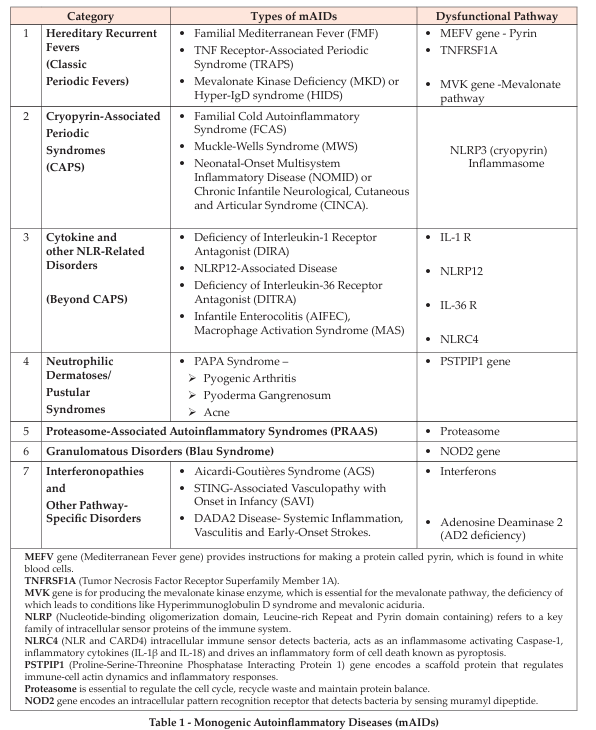
Monogenic Autoinflammatory Diseases (mAIDs – not to be confused with MAIDs) are very rare (affecting <5 per 10,000 people), and can be broadly categorised into several groups based on their clinical presentation and underlying genetic defects or dysfunctional pathways.5 (Table 1)
Symptoms of mAIDs can include:
- Recurring, unprovoked fevers that can last from a few days to a few weeks.
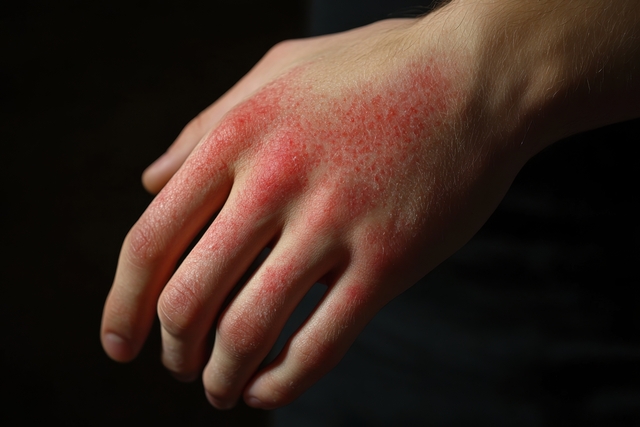
- Skin rashes or hive-like (urticarial) plaques.
- Joint swelling and pain (arthralgia/arthritis).
- Severe localised muscle pain (myalgia).
- Severe abdominal pain, vomiting, and diarrhoea.
- Painful conjunctivitis (pink eye), uveitis.
- Sensorineural hearing loss.
- Swollen lymph nodes (lymphadenopathy).
- Enlargement of the spleen or liver.
Diagnosis is mainly by Molecular Genetic Testing being the gold standard for confirming a mAID diagnosis by analysing specific candidate genes (such as MEFV, TNFRSF1A, MVK, or NLRP3) associated with classic periodic fever syndromes.6 Supportive tests include blood tests during flares (CBC, ESR, CRP) and serum amyloid A (SAA).
Treatment of mAIDs
The understanding of the pathophysiology of many autoinflammatory diseases have led to the use of IL-1 blocking medications for many chronic and disabling diseases.7 Anakinra as a daily subcutaneous injection, is used for Cryopyrin-Associated Periodic Syndromes (CAPS), DIRA (Deficiency of IL-1 Receptor Antagonist), and Familial Mediterranean Fever (FMF). Canakinumab, a long-acting anti IL-1, injected subcutaneously every 4 to 8 weeks is commonly used for CAPS, FMF, and MKD. Not all mAIDs respond to IL-1 inhibitors, and may require specific non-biologic medications to target unique pathophysiological pathways.8
NSAIDs are used as a supplementary, symptomatic treatment during acute inflammatory flare-ups for many mAIDs to provide temporary pain relief. Colchicine remains the gold-standard first-line treatment for FMF and reduces the frequency of attacks and prevents severe long-term complications like amyloidosis. Statins (like simvastatin) are used in MKD (Hyper-IgD syndrome), to reduce mevalonic acid production, with or without anti-IL-1 drugs. Other therapies include Interleukin-6 (IL-6) inhibitors like tocilizumab, and Janus Kinase (JAK) inhibitors (tofacitinib). Anti-TNF Agents: Drugs like etanercept, infliximab, and adalimumab are typically used in TRAPS, PAPA, and DADA2 (Deficiency of ADA2) to control joint inflammation and skin manifestations. IL-18 Blocker (Tadekinig alfa) is considered in NLRC4-related autoinflammatory diseases.
Polygenic
The most well-known polygenic autoinflammatory diseases are Gout and Pseudogout (also called Crystal-induced arthritis CIA).9 Others include Sarcoidosis, Still’s Disease, and some other rare conditions.10 As mentioned, sometimes conditions like IBD, psoriatic arthritis, some large vessel arteritis (vasculitis), and idiopathic uveitis are also considered in this category, or grouped under autoimmune or related conditions by others.
Gout and Pseudogout
Gout occurs when the innate immune system responds excessively to uric acid (monosodium urate MSU) needle-shaped crystals that glow blue under a polarized microscope (negatively birefringent), deposited in joints when serum uric acid levels are elevated past their solubility threshold.
Pseudogout is similar clinically to gout, but the crystals are those of calcium pyrophosphate dihydrate (CPPD) that are rhomboid-shaped and glow yellow (positively birefringent).
While both gout and pseudogout manifest similarly as pain and inflammation of joints, gout tends to affect small joints like toes and fingers, while pseudogout affects the knee, or the elbow and wrist more.
Acute Flares of pain and inflammation whether gout or pseudogout, are managed with NSAIDs as first-line, oral colchicine when NSAIDs are contraindicated or inadequate, or in severe attacks, corticosteroid by oral, intra-articular (if gout affecting only one or two joints), or intramuscular (for patients who cannot take oral medication) route.
Long-Term Management of gout rests on diet and lifestyle modification, treating underlying medical conditions and long-term medicines to prevent flares like Urate-Lowering Therapies (ULT – Xanthine Oxidase enzyme Inhibitors – allopurinol and febuxostat) that reduce uric acid production, and Uricosurics like probenecid that helps the kidneys excrete uric acid. Low-dose colchicine is sometimes used for the first few months when starting ULT to prevent initial flares, and for those with pseudogout.
Recurrent Flares and Refractory Gout (<5% patients) which include those with frequent flares (>2/year), non-responsive to or not tolerating NSAIDs or colchicine, and with contraindication or non-response to corticosteroid use, are treated with IL-1 inhibitors, or pegloticase with methotrexate.
Other Polygenic Autoinflammatory Conditions
Sarcoidosis is a condition that leads to inflammation (in the form of grain-like lumps called granulomas), usually in the lungs, skin, or lymph nodes, but can affect any organ. It may be asymptomatic in some or present with symptoms like cough, shortness of breath, weight loss, night sweats, and fatigue. Diagnostic tests include a chest x-ray, lung function tests, and a biopsy. Corticosteroids or immunosuppressants are used in significantly symptomatic or severe cases.
Still’s Disease is a rare autoinflammatory disorder characterised by a classic triad of high spiking daily fevers, severe joint pain, and an evanescent salmon-pink rash. It affects both children (systemic Juvenile Idiopathic Arthritis – sJIA) and adults (Adult-Onset Still’s Disease -AOSD) and is managed primarily by rheumatologists using immunosuppressive and biologic medications.
Behçet’s disease is a rare, chronic inflammatory vasculitis affecting vessels throughout the body, leading to painful sores (mouth, genital), eye inflammation (uveitis), skin rashes/nodules, arthritis, and potentially severe problems in the brain, gut, or major vessels.
PFAPA Syndrome (Periodic Fever, Aphthous stomatitis, Pharyngitis, and Adenitis) predominantly affects young children, causing recurring bouts of fever and swollen lymph nodes. PFAPA episodes are treated with corticosteroids, colchicine, NSAIDs and in certain cases, tonsillectomy and MAbs.
Chronic Recurrent Multifocal Osteomyelitis (CRMO), also known as Chronic Non-Bacterial Osteomyelitis (CNBO), causes sterile, painful inflammation in the bones.
Schnitzler syndrome is a rare, acquired autoinflammatory disorder typically emerging in middle age, characterised by a chronic, hive-like rash and raised IgM antibodies. Symptoms include recurrent fevers, bone/joint pain, and swollen lymph nodes.
Other very rare conditions are Sweet’s Syndrome (acute febrile neutrophilic dermatosis) and Idiopathic Recurrent Pericarditis.
Conclusion
Autoinflammatory diseases are a spectrum of disorders with a rarer monogenic and commoner polygenic inheritance conditions. Autoinflammatory Awareness Month is internationally recognised and observed every year in August to increase awareness and promote research, specialised care, and early diagnosis for Autoinflammatory Diseases. It is important for general and family physicians to develop awareness, and understanding to enable clinical suspicion, diagnosis, management and appropriate referral of autoinflammatory diseases.
References
- An J, Marwaha A, Laxer RM. Autoinflammatory Diseases: A Review. The Journal of Rheumatology Sep 2024, 51 (9) 848-861.
- Kim YD. Systemic autoinflammatory disorders: autoinflammatory and autoimmune disorders. Clin Exp Pediatr. 2023 Oct;66(10):439-440.
- Amikishiyev S, Kalaycı T, Deniz R, Soltanova L, Sen B, Yalçınkaya Y, et al. Phenotypes of patients with more than one autoinflammatory disease-associated gene variant: overlapping and mixed autoinflammatory disorders. Rheumatology (Oxford). 2026 Feb 4;65(2):keaf582.
- Krainer J, Siebenhandl S, Weinhäusel A. Systemic autoinflammatory diseases. Journal of Autoimmunity,2020; 109:102421, ISSN 0896-8411.
- Nigrovic PA, Lee PY, Hoffman HM. Monogenic autoinflammatory disorders: Conceptual overview, phenotype, and clinical approach. J Allergy Clin Immunol. 2020 Nov;146(5):925-937.
- Le Goueff A, Smits G, Delaunoy M, Vandernoot I, Vandergheynst F. Genetic testing in autoinflammatory diseases – past, current and future perspectives. Eur J Intern Med. 2022 Dec;106:71-79.
- Semo-Oz R, Biton B, Tesher MS. The Role of Anti–IL-1 Medications in Autoinflammatory Disease. Pediatric Annals. 2022;51(2):e72-e76.
- Blackstone S, Kastner D, Broderick L. Autoinflammatory syndromes: Updates in management. Journal of Allergy and Clinical Immunology, 2023; 153, 85-89.
- Oliviero F, Bindoli S, Scanu A, Feist E, Doria A, Galozzi P and Sfriso P. Autoinflammatory Mechanisms in Crystal-Induced Arthritis. Front. Med. 2020; 7:166.
- Ombrello MJ. Advances in the genetically complex autoinflammatory diseases. Semin Immunopathol. 2015 Jul;37(4):403-6.