















Abstract
The month of September is observed as Polycystic Ovary Syndrome (PCOS) month, which is now officially called Polyendocrine Metabolic Ovarian Syndrome (PMOS). The change was driven by a 14-year global consensus process involving patients and experts to emphasize that the condition has diverse endocrine and metabolic features, requires multi-modal care. An accurate new name was prioritised by omitting cysts and by capturing endocrine, metabolic, and ovarian dysfunction to prevent missed or delayed diagnosis. Adding “metabolic” and “polyendocrine” highlights insulin resistance, systemic hormone imbalances, and long-term cardiometabolic risks steering care toward holistic, whole-body management, across specialties and systems.
Keywords: Polycystic Ovary Syndrome (PCOS); Polyendocrine Metabolic Ovarian Syndrome (PMOS); Insulin Resistance; Ovarian Dysfunction and Hyperandrogenism.
Introduction
Polycystic Ovary Syndrome (PCOS) is now officially called Polyendocrine Metabolic Ovarian Syndrome (PMOS). The inaccuracy and need to change the term have been recognized for over a decade globally, including in India.1,2 The change was driven by a 14-year global consensus process involving patients and experts to correct the old, misleading name, reduce medical stigma, and emphasize that the condition impacts the whole body’s metabolism and hormone systems rather than just causing ovarian cysts.3
The term PCOS implies pathological ovarian cysts, obscuring diverse endocrine and metabolic features, thereby contributing to delayed diagnosis, and mono-modal care. Building on an international mandate for change, an unprecedented, rigorous, multistep global consensus process for the name change was outlined. Funding and governance were established with engagement of 56 leading academic, clinical, and patient organisations. Using iterative global surveys (with responses from >14000 people with the condition, and multidisciplinary health professionals from all world regions, modified Delphi methods, nominal group technique workshops, and marketing and implementation analyses, principles prioritising scientific accuracy, clarity, stigma avoidance, cultural appropriateness, and implementation feasibility were identified. An accurate new name was prioritised over retaining the PCOS acronym or a generic name, by omitting cysts and by capturing endocrine, metabolic, and ovarian dysfunction.3
The Rationale Behind the Change from PCOS to PMOS
- Inaccuracy of “Polycystic”: The old term suggested that ovarian cysts were a defining feature, but many diagnosed individuals never develop true cysts (the ultrasound spots are usually immature follicles), leading to delayed or missed diagnoses.
- Not limiting to “Ovaries”: Framing it as a mere “ovarian syndrome” minimized it into a localized reproductive issue, ignoring that it is a complex, systemic, multi-system disorder.
- Including Endocrine and Metabolic Pathophysiology: Adding “metabolic” and “polyendocrine” highlights insulin resistance, systemic hormone imbalances, and long-term cardiometabolic risks like type 2 diabetes, metabolic syndrome and overweight/obesity.4
- Patient Acceptance and Advocacy: Driven by thousands of patient responses worldwide, the new nomenclature aims to improve clinical awareness, reduce psychological stigma, and develop care toward holistic, whole-body management, across specialties and systems.
However, Experts warn that care must be taken to introduce the name gradually so as not to confuse patients or detract from efforts to raise awareness about the condition.5
Pathophysiology
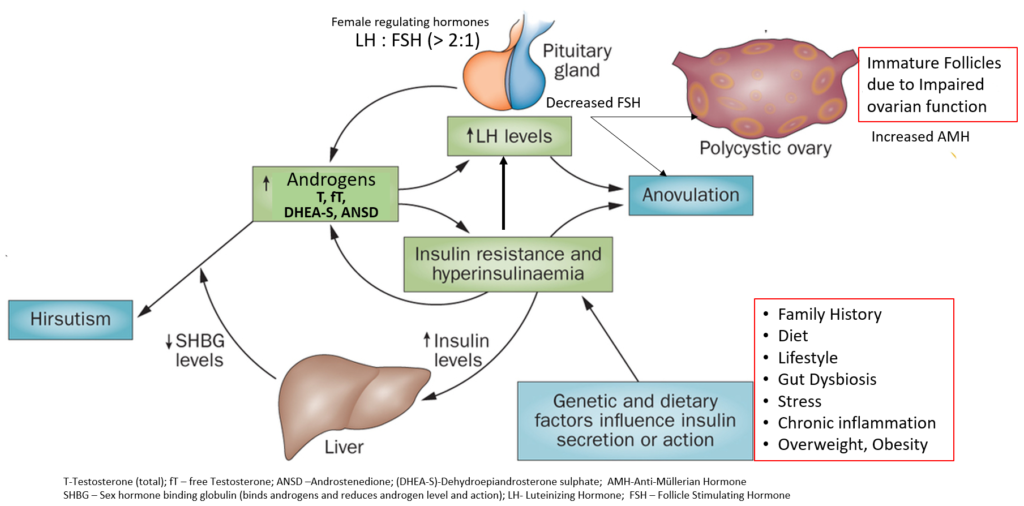
The pathophysiology of PMOS is complex and multifactorial, with aberrations in ovarian steroidogenesis, insulin resistance, hyperinsulinemia, high antimullerian hormone (AMH), and excess luteinizing hormone (LH) resulting from dysfunction of the hypothalamic-pituitary-ovarian (HPO) axis, and overexpression of most steroidogenic enzymes and proteins involved in androgen synthesis. The bidirectional link between hyperinsulinemia and androgen excess is an essential pathogenetic feature. Etiology for this dysregulation involves insulin resistance leading to hyperinsulinemia, which is seen in 70% of females with PMOS which is now widely regarded not as a dysfunction of ovaries alone but an interplay of metabolic, and hormonal factors, with insulin resistance often being the connecting piece.6 Figure 1 describes the pathophysiology and risk factors at play.
Diagnostic Criteria
According to the revised Rotterdam criteria, a diagnosis of PMOS (PCOS) is recommended if two of the below conditions are met7:
- Hyperandrogenism indicators (Biochemical or Clinical)
- Biochemical: Elevated concentrations of total (T) or free testosterone (fT), or calculated free androgen index (FAI) or bioavailable testosterone (BioT).
- Clinical: Modified Ferriman–Gallwey Hirsutism score between 24 and 28, indicative of pronounced clinical manifestations of hyperandrogenism.
- Oligo-anovulation signs – Oligo-amenorrhea, characterized by menstrual cycles exceeding 35 days in length or fewer than 8 cycles per year.
- Ultrasound findings by high-resolution transvaginal ultrasonography with a transducer frequency ≥ 8 MHz, showing polycystic-appearing ovarian morphology (assuming that other related disorders have been ruled out) – Presence of ≥20 antral follicles in one or both ovaries, or an ovarian volume exceeding 10 cm3
In cases where oligo-amenorrhea is absent, but clinical suspicion for PCOS remains high, other diagnostic approaches such as serum progesterone levels or luteinizing hormone (LH) assays should be employed to evaluate ovulatory dysfunction. Further evaluations with androstenedione (ANSD) and dehydroepiandrosterone sulphate (DHEA-S), may be considered to augment diagnostic accuracy.8
Management
The PMOS treatment algorithm depends additionally on whether the patient is desirous of pregnancy during the treatment phase.9,10 Lifestyle measures include diet, exercise and weight management. For those currently not desirous of pregnancy, oral contraceptives are recommended, while for those desirous of pregnancy, ovulation inducers and gonadotropins are first- and second-line therapies. Acne and hirsutism would need appropriate topical or oral drugs, and cosmetic aid.
Central to management of PMOS, remains reducing insulin resistance, with metformin being the most studied, established and evidence based first-line therapy.11 The evidence supporting the use of inositol (myoinositol MI and D-chiro inositol DCI) is still evolving. A metanalysis of 10 studies compared MI to metformin showed no differences between groups for metabolic, lipid, most anthropometric (fasting glucose, insulin, HOMA-IR, cholesterol and weight), and reproductive outcomes (resumption of normal menstrual cycles, ovulation rate clinical pregnancy rates, miscarriage rates).12 In a metanalysis of 5 studies, the combination of metformin and inositol was associated with a higher rate of menstrual cycle regularisation.13 Two studies from the Indian subcontinent of 6 months duration compared MI-DCI combined with metformin versus metformin alone and showed that the combination produced statistically significant improvements in cycle regularity and ovulation, and reduction in LH and LH/FSH, cholesterol, and insulin, suggesting that combined therapy with metformin and inositols in PMOS with insulin resistance may hold promise with the need for further larger studies.14,15
Conclusion
Polycystic Ovary Syndrome (PCOS) has been renamed to Polyendocrine Metabolic Ovarian Syndrome (PMOS) based on an international mandate and multistep global consensus for an accurate new name over retaining the PCOS acronym by omitting cysts and by capturing endocrine, metabolic, and ovarian dysfunction. As known, many diagnosed individuals never develop true cysts and projecting it as an ovarian syndrome minimized it into a localized reproductive issue, when it is actually a complex, systemic, multi-system disorder. Adding “metabolic” and “polyendocrine” highlights insulin resistance, systemic hormone imbalances, and long-term cardiometabolic risks like type 2 diabetes, metabolic syndrome and overweight/obesity. The pathophysiology of PMOS is complex and multifactorial that involves insulin resistance leading to hyperinsulinemia, with an interplay of metabolic, and hormonal factors. The new name is also a result of patient responses worldwide, to improve clinical awareness, reduce stigma, and develop a holistic and wider management across specialties and systems. The new name is to be introduced gradually and seamlessly without hindering patient awareness, and care.
References
- Khadilkar SS. Polycystic Ovarian Syndrome: Is It Time to Rename PCOS to HA-PODS? J Obstet Gynaecol India. 2016 Apr;66(2):81-7
- Taieb A, Asma G, Jabeur M, Fatma BA, Nassim BHS, Asma BA. Rethinking the Terminology: A Perspective on Renaming Polycystic Ovary Syndrome for an Enhanced Pathophysiological Understanding. Clin Med Insights Endocrinol Diabetes. 2024 Oct 28;17:11795514241296777
- Teede H, Khomami M, Morman R, Laven JSE, Joham AE, Costello MF, et al. Polyendocrine metabolic ovarian syndrome, the new name for polycystic ovary syndrome: a multistep global consensus process. The Lancet, 2026; 407, 2329-2339
- Shruthi S, Lakshmi G, T S M, Washington JK. Prevalence and Predictors of Metabolic Syndrome in Women with Polycystic Ovarian Syndrome: A Cross-Sectional Study. Cureus. 2025 Dec 10;17(12):e98869.
- PCOS name change to PMOS must be managed to avoid confusing patients, says expert. BMJ2026; 393:S955
- Shukla A, Rasquin LI, Anastasopoulou C. Polyendocrine Metabolic Ovarian Syndrome. [Updated 2025 Jul 7]. In: StatPearls [Internet]. Treasure Island (FL): StatPearls Publishing; 2026 Jan-. Available from: https://www.ncbi.nlm.nih.gov/books/NBK459251/
- Ghafari A, Maftoohi M, Samarin ME. Barani S, Banimohammad M, Samie R. The last update on polycystic ovary syndrome (PCOS), diagnosis criteria, and novel treatment. Endocrine and Metabolic Science. 2025; 17(1): 100228.
- Joham AE, Tay CT, Laven J, Louwers YV, Azziz R, Approach to the Patient: Diagnostic Challenges in the Workup for Polycystic Ovary Syndrome, The Journal of Clinical Endocrinology & Metabolism, July 2025;110 (7): e2298–e2308.
- Teede HJ, Tay CT, Laven J, Dokras A, Moran LJ, Piltonen TT, et al. Recommendations from the 2023 International Evidence-based Guideline for the Assessment and Management of Polycystic Ovary Syndrome. Human Reproduction, 2023; 38(9), 1655-1679.
- Panchpuri M, Kisku A, Painuli R, Pant G, Kumar C. Polycystic ovary syndrome (PCOS): current insights, emerging therapeutics, and future treatment strategies. Inflammopharmacology. 2026 Feb;34(2):1005-1040.
- Teede HJ, Tay CT, Laven JJE, Dokras A, Moran LJ, Piltonen TT, et al, on behalf of the International PCOS Network. Recommendations From the 2023 International Evidence-based Guideline for the Assessment and Management of Polycystic Ovary Syndrome, The Journal of Clinical Endocrinology & Metabolism, Oct 2023; 108(10): 2447–2469,
- Fitz V, Graca S, Mahalingaiah S, Liu J, Lai L, Butt A, et al. Inositol for Polycystic Ovary Syndrome: A Systematic Review and Meta-analysis to Inform the 2023 Update of the International Evidence-based PCOS Guidelines, The Journal of Clinical Endocrinology & Metabolism, June 2024;109(6):1630–1655.
- Sobral, M.V.S., Soares, V.G., Faria, H.S., Bendaham, L.C.A.R., Masiero, B.B., Gonçalves, O.d.D.d.R.R., Barreiros, F.A. and de Moraes, M.A.G. (2025), Inositol With Metformin Versus Metformin Monotherapy in Polycystic Ovary Syndrome: A Meta-Analysis of Randomised Controlled Trials. Reproductive, Female and Child Health, 4: e7003
- Bahadur A, Arora H, Ravi A K, Naithani M, Bahurupi Y, Chaturvedi J, et al. Comparison of Clinical, Metabolic and Hormonal Effects of Metformin Versus Combined Therapy of Metformin with Myoinositol Plus D-Chiro-Inositol in Women with Polycystic Ovary Syndrome (PCOS): A Randomized Controlled Trial. Cureus June 2021;13(6): e15510.
- Khatun K, Islam S, Ferdous MS, Sultana N, Meem TE, Afroz R, et al. Efficacy of Myo-Inositol plus D-Chiro-Inositol versus Metformin in the Management of Polycystic Ovary Syndrome among Obese Infertile Women in Bangladesh. The Insight 2026; 9(1): 36-40