

















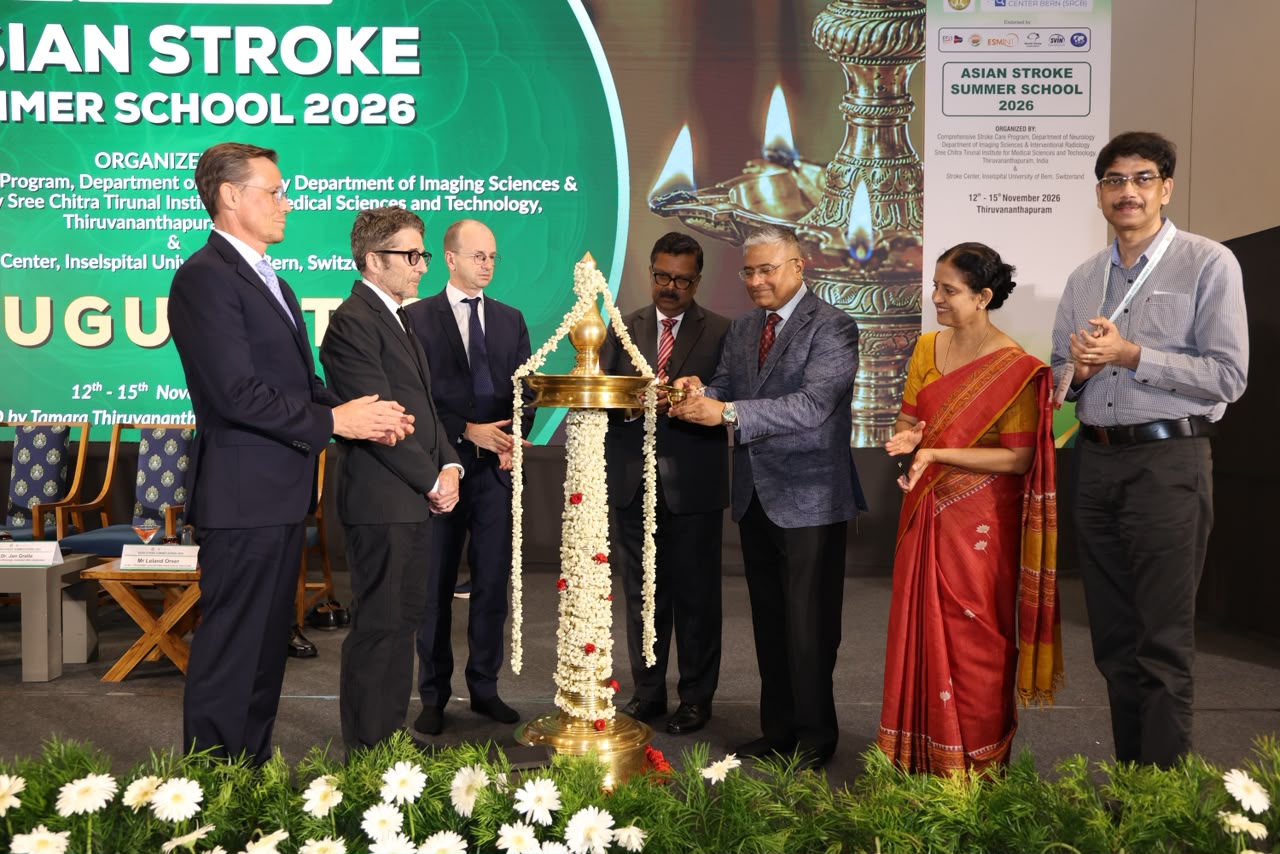
Thiruvananthapuram: Healthcare professionals must look beyond medical technology and address the financial and practical challenges faced by stroke patients and their families, Surgeon Vice Admiral Shankar Subramanian, Director General Medical Services (Navy), said at the Asian Stroke Summer School 2026.
Inaugurating the international training programme in Thiruvananthapuram, he highlighted the need to make stroke treatment more affordable and accessible, particularly for families with limited financial resources. Drawing from his own family’s experience of arranging a home-based intensive care unit (ICU) for his late father-in-law due to the high cost of hospital care, he urged doctors to consider the financial impact of treatment while planning patient care.
Experts Highlight Need for Affordable and Accessible Stroke Care
Surgeon Vice Admiral Subramanian advocated for practical healthcare solutions, including hybrid online consultations, decentralised diagnostic facilities and affordable home-care services. He emphasised that healthcare professionals should adopt a more empathetic approach towards treatment expenses and the challenges patients face during recovery.
The Asian Stroke Summer School 2026 is jointly organised by the Sree Chitra Tirunal Institute for Medical Sciences and Technology (SCTIMST) and the Stroke Research Centre Bern (SRCB), Switzerland, with support from the World Health Organization (WHO). The programme aims to strengthen stroke care through international collaboration and specialised medical training.
Prevention Remains Key to Reducing Stroke Burden
Speaking at the event, former Kerala Chief Secretary Jiji Thomson stressed that stroke prevention remains essential despite advancements in artificial intelligence (AI), robotics and precision medicine.
He highlighted the importance of simple lifestyle measures, including regular brisk walking, blood pressure and diabetes management, avoiding tobacco and maintaining healthy sleep habits. He also emphasised that preventive measures can make a significant difference in reducing stroke risk without requiring expensive medical interventions.
International Experts Stress Collaboration in Stroke Treatment
Dr. Urs Fischer, Chairman of the Department of Neurology at University Hospital Bern, discussed the global expansion of the Asian Stroke Summer School initiative. Launched in Europe in 2014, the programme has since expanded to Asia and Latin America to strengthen stroke care systems, particularly in low- and middle-income countries.
Meanwhile, Dr. Jan Gralla, Head of Neuroradiology at Inselspital Bern, highlighted the importance of coordination among neurologists, neurosurgeons, interventional specialists and hospital staff. He also stressed the need to train the next generation of healthcare professionals to improve stroke management.
Personal Experiences Highlight Importance of Timely Stroke Treatment
Adding a personal perspective, American actor Leland Orser shared his 87-year-old mother’s experience of recovering from a severe stroke following prompt medical intervention. He recalled that timely treatment helped her regain her ability to speak within 24 hours and provided her with another 18 months of quality life.
Earlier, Dr. P. N. Sylaja, Professor and Head of the Comprehensive Stroke Care Programme at SCTIMST, welcomed the gathering. Dr. E. R. Jayadevan, Professor and Head of the Department of Imaging Sciences and Interventional Radiology at SCTIMST, delivered the vote of thanks and felicitated the guests. As per the press release, the Asian Stroke Summer School 2026 aims to strengthen stroke care through international knowledge-sharing, professional training and collaboration, while highlighting the need for affordable, accessible and patient-centred treatment.