

















Gaza: A Mission Like No Other
In the course of my 20-year journey as a volunteer surgeon, I have travelled across continents, treating patients in Cambodia, Myanmar, China, Uganda, Nigeria, and beyond (nearly 15 to 20 countries). But Gaza stands apart. It was there, in one of the most politically sensitive and physically confined corners of the world, that I experienced the rawest intersection of war and healing, of pain and hope.
Crossing Borders, Facing Scrutiny
Between 2013 and 2014, I undertook three missions to Gaza under the aegis of Médecins Sans Frontières (MSF) France. The path to volunteering with MSF is not for the faint-hearted. The recruitment process itself was rigorous: group discussions, psychological evaluations, simulated field scenarios with fast-evolving dilemmas, and a personal interview that probed not just qualifications but temperament. Once selected, the real challenge began.
Securing an Israeli visa involved intense scrutiny. My entire familial background was vetted, right down to my maternal grandparents. I needed a character certificate from the district police headquarters. And then came the caveat: visiting Gaza meant bearing a passport stamp that would close the doors to many Islamic nations. But I was prepared. This wasn’t a holiday. It was a calling.
My first entry into Israel in September 2013 was marked by the sort of bureaucratic suspicion that accompanies any travel into a conflict zone. At Tel Aviv airport, I was taken aside for questioning — I had been warned this was standard. “Be brief and direct,” I was advised. After ten minutes of terse replies, I was allowed through. At the arrivals lounge, I met Murad, a Palestinian MSF driver, who handed me an envelope with a pre-set mobile phone, a charger, and instructions.
I was taken to East Jerusalem, where MSF maintained residential quarters and offices. The area was predominantly Palestinian, with a blend of Muslim and Christian communities (the Jews stayed in posh west Jerusalem with a feel of Alexandar Platz in Berlin). The first evening included an unexpected but memorable tour of the Old City with Ajin Kim, our Korean HR manager. We walked through the Christian quarter, visited the Church of the Holy Sepulchre, and paced along the Via Dolorosa. That evening, over my first falafel and shawarma dinner, I began to absorb the cultural layers of this land.
My journey to Gaza began the next day in an MSF land cruiser, with the convoy led by senior MSF staff. The vehicle, marked by identifiers recognised by drones and fighter planes, carried satellite phones and emergency supplies. As we approached the Erez Crossing, a vast and intimidating border crossing between Israel and Gaza, the landscape changed dramatically. What lay ahead was a concrete labyrinth watched over by cameras, towers, and high walls. After intense security checks, I was instructed to drag my luggage for nearly two kilometres through a zigzag corridor flanked by barbed wire. No-man’s-land, in every sense.
On the Gaza side, I was greeted by two local MSF drivers, Abu Ayaman and Abu Shadi. Their warm smiles contrasted starkly with the grim surroundings. We drove through Bet lehiya to Gaza City to the MSF compound — a fortified building housing both residential quarters and office space. Weapons, regardless of context, were strictly prohibited inside MSF spaces. This rule held even in the most dangerous zones, and was a defining ethos of the organization.
Daily Life in the MSF Compound
Each day began early. I would wake by 5:45 am, ensure I got to the shared bathroom before others, and cook myself breakfast: an omelette, local bread, and Sholapuri peanut chutney I had brought from home. Our team would gather at 7:15 am for the daily security briefing. Information from local staff and drivers helped us map the safest route to Khan Younis, where MSF operated a field hospital in the parking lot of Al Nasser Hospital.
Surgery in a War Zone
The field hospital was a marvel of logistical efficiency — two inflatable interconnected tents with air-conditioning, triage beds, a semi-sterile scrub area, and a well-equipped operating theatre. Despite the heat that could reach 45-50°C, we worked tirelessly. In my first 6-week stint, we completed over 26 surgical days. We triaged over 70 patients and operated on more than 90 across my three missions.
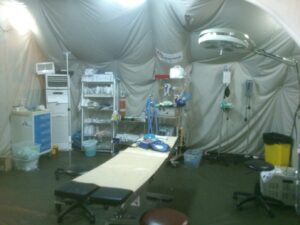
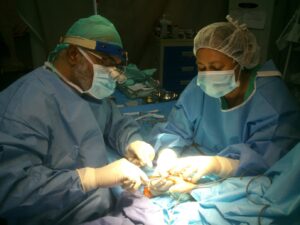
The surgeries were mainly reconstructive: post-burn contractures, congenital anomalies like syndactyly and polydactyly, and war injuries. Children formed a large portion of our patient base. In refugee camps, open fires and propane stoves often led to severe burns in small children. I vividly recall a child with a rare mirror-foot deformity and another with devastating injuries from a mishandled circumcision. These were not just surgical cases. They were human stories of suffering, resilience, and trust.
Human Connections and Culture
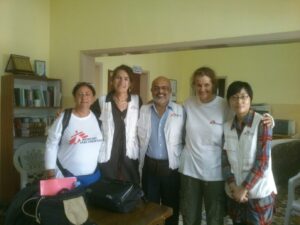
Our team was diverse: An Italian OT nurse, a Korean anaesthetist, local scrub nurses, and Abu Khalid — our multitasker who managed coffee, instruments, and morale. The thick, unsweetened Arabic coffee he brewed was our fuel. Ten to fifteen small cups a day was not unusual. The coffee pot became a symbol of camaraderie.
Language was rarely a barrier. Many Gazans assumed I was Arab — perhaps due to my bald head and beard. When I corrected them: “Doctur Hind,” meaning Indian Doctor they would respond with genuine warmth: “Mumtaz!” (Excellent!) There was a sense of brotherhood that transcended nationalities.
The MSF physiotherapy and rehabilitation services in Gaza were exemplary. A local physiotherapist, who also doubled as prosthetist and splint-maker, ran a service that rivalled any advanced setup I’d seen in India. Pressure garments, face masks, silicone sheets — all fabricated locally, and with immense care. Sadly, I later learnt part of this setup was destroyed in a bombing.
Tensions escalated during my final mission in June 2014. Drones buzzed above; fighter jets flew low. We heard explosions at night. After three Jewish teenagers were kidnapped from the West Bank, there were fears of an imminent ground invasion. MSF prepared for evacuation, yet we continued surgeries at Al Shifa Hospital. Our final week was spent operating under the shadow of war, handing over supplies as the situation grew dire.
One of the great joys of these missions is the friendships forged. I had the privilege of meeting Prof Christophe Oberlin, a legendary French surgeon (Doyen of Brachial Plexus Injuries) who had travelled to Gaza 17 times, often through tunnels from Egypt. Working alongside him was both humbling and inspiring.
Across 27-28 operative days, I performed more than 90 surgeries. These weren’t just clinical successes; they were acts of defiance against despair. Each child who smiled after surgery, each limb salvaged, each contracture released, was a quiet triumph.
Gaza receives generous international aid, particularly from Qatar and the UN, and paradoxically, I saw less abject poverty there than in parts of rural India. But Gaza remains a prison — its residents unable to leave without Israeli permits. Yet, within those walls, I met warmth, grace, and gratitude.
A word of caution — Volunteering is addictive. The withdrawal is real. Due to the COVID pandemic, I missed the cleft and NOMA missions in 2020 and 2021. And not a day passes without yearning to return.
Gaza was not just a mission. It was a reminder of why we become surgeons: to heal, to listen, and to stand by the wounded when the world turns away.
Hope Interrupted: Gaza 2023
I returned to Gaza for a fourth time in July–August 2023, spending over a month there. I left just a month before the October 7th attack — the deadliest massacre of Jews since the Holocaust. This time, my mandate with MSF was different: I had been entrusted with helping to establish a formal plastic surgery residency program in Gaza, in collaboration with the Palestinian Medical Council, the Ministry of Health Gaza, and with the aim of certification by the European Board of Plastic Surgery.
As a sub-specialist in cleft and craniomaxillofacial surgery, I was also tasked with reorganizing and centralizing cleft care services in Gaza — a much-needed initiative. Alongside my mentor in MSF, Dr. Chanjeev Singh, and Dr. Ghassan Abu-Sittah — a UK-based plastic surgeon of Lebanese-Palestinian origin and a well-known figure in humanitarian surgery — we had nearly finalized the framework for both programs.
Tragically, all of this was brought to a halt. The devastating attack by Hamas, followed by Israel’s relentless retaliation, has left Gaza in ruins. The war rages on. The vision we had so carefully shaped now lies buried under the rubble.
But that is a story for another day.
Republished from the July 2025 issue of KMA Flash, published by the Kolhapur Medical Association with permission.