





















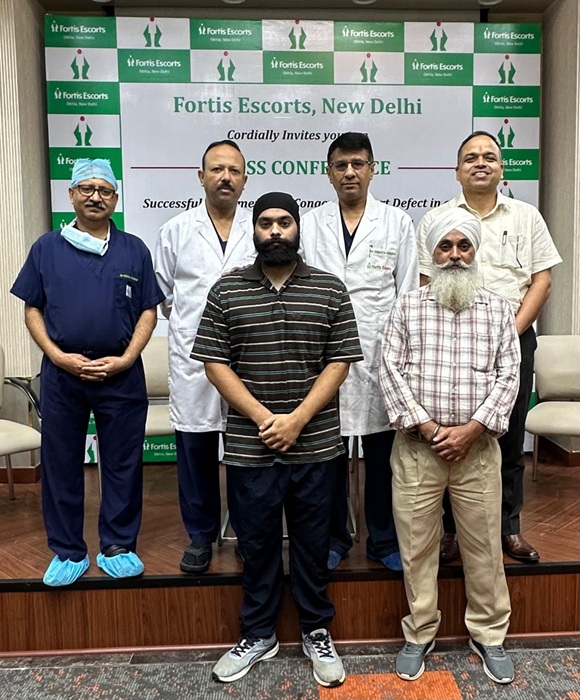
Doctors at Fortis Escorts, Okhla, have successfully repaired a large congenital heart defect in a 26-year-old Merchant Navy officer using robot-assisted minimally invasive surgery. The procedure, led by Dr. Ritwick Raj Bhuyan, Senior Director, Cardio Thoracic Vascular Surgery, and Dr. Nishith Chandra, Principal Director, Cardiology, helped the patient move closer to resuming his professional career.
Congenital Heart Defect Detected During Screening
The patient discovered the condition during a routine health assessment after he had already joined the Merchant Navy. While his earlier mandatory medical screening had not detected the defect, a subsequent echocardiogram revealed a large atrial septal defect (ASD)—an opening between the heart’s upper chambers.
The defect increased blood flow to the lungs and placed additional strain on the right side of the heart. Consequently, doctors declared him medically unfit for service and referred him to Fortis Escorts, Okhla, for further treatment.
Robotic Surgery Enables Faster Recovery
As per the hospital’s press release, the cardiac team found the defect unsuitable for catheter-based device closure because of its size and anatomy. Therefore, doctors used the Da Vinci Xi robotic surgical system to access the heart through small ports and a limited incision, avoiding conventional splitting of the breastbone.
The team repaired the defect with a specialised patch. The surgery proceeded without complications, and doctors removed the patient from the ventilator on the same day. He subsequently made a smooth recovery and was discharged with normal heart function.
Advanced Care for Young Patients
Dr. Ritwick Raj Bhuyan said the minimally invasive approach allowed the team to repair the large defect while supporting a quicker recovery. Dr. Nishith Chandra added that the patient’s age, health and professional requirements influenced the decision to use robotic-assisted surgery.
Dr. Vikram Agarwal, Regional Director, Fortis Escorts Hospital, Okhla, said the case demonstrates how advanced technology and clinical expertise can expand minimally invasive treatment options and support faster recovery for young patients.