




















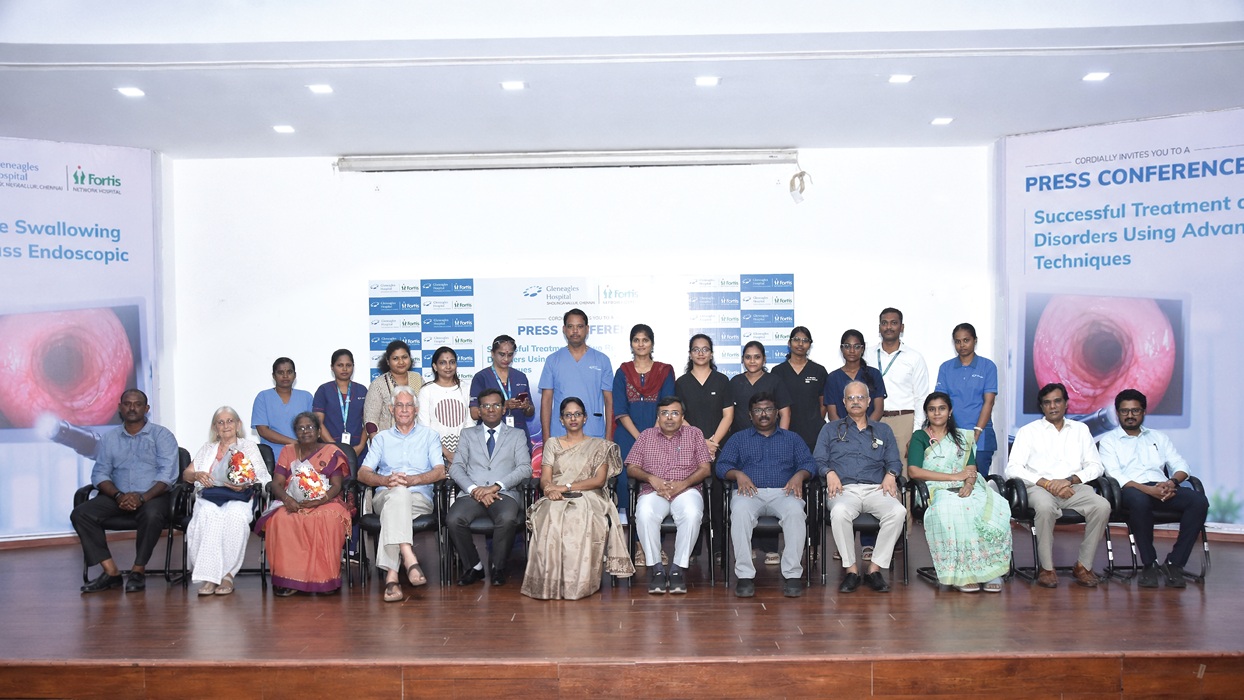
Gleneagles Hospital Chennai, part of the Fortis Healthcare Network, has successfully treated two elderly patients with rare and complex swallowing disorders through advanced endoscopic procedures. The hospital used D-POEM for an Epiphrenic Diverticulum and Z-POEM with modified septotomy for Zenker’s Diverticulum.
Complex Achalasia Treated Through D-POEM
A 73-year-old woman from Jayankondam, Ariyalur District, had struggled to swallow food and liquids for nearly three years. Her condition had worsened, with frequent vomiting, difficulty tolerating liquids and significant weight loss.
Investigations revealed Achalasia with a large Epiphrenic Diverticulum. According to the press release, Dr. B. Mahadevan and his team performed Diverticular Peroral Endoscopic Myotomy (D-POEM) on March 30, 2026, entirely through the mouth and without an external incision. The hospital stated that this was the first D-POEM for an Epiphrenic Diverticulum performed by a doctor in Tamil Nadu.
The patient recovered well and was discharged after three days. At her one-month follow-up, she reported significant improvement in swallowing.
Z-POEM Brings Relief After a Decade of Symptoms
In another case, a 75-year-old man from Belgium, who has been living in India, had lived with Zenker’s Diverticulum for nearly 10 years. He experienced regurgitation, coughing and a persistent gurgling sensation that affected his sleep and eating.
Evaluation revealed a large 5-cm Zenker’s Diverticulum. Dr. Mahadevan and his team performed Z-POEM with modified septotomy through an endoscopic approach without an external incision.
At his one-month follow-up, the diverticulum had opened and flattened, restoring normal food passage. The patient reported complete relief from regurgitation and nighttime disturbances.
Advancing Minimally Invasive Care
Dr. B. Mahadevan, Senior Consultant, Gastroenterology, Gleneagles Hospital Chennai, said, “Both cases were clinically challenging, but advanced endoscopic techniques allowed us to treat these conditions without external surgery.”
The successful outcomes highlight the role of advanced, minimally invasive endoscopic techniques in managing complex swallowing disorders while supporting faster recovery and improved quality of life.