






















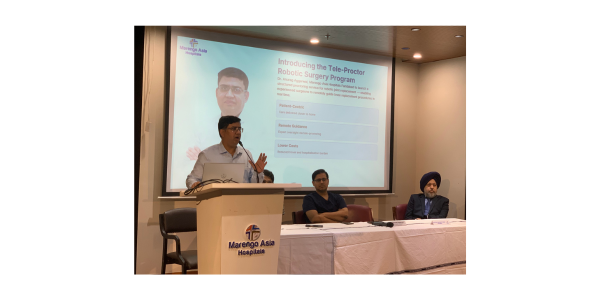
As robotic-assisted knee replacement surgery continues to transform orthopaedic care, tele-proctoring is emerging as a key enabler of safe adoption, improved surgical precision, and better patient outcomes. To make advanced robotic knee replacement procedures accessible to patients in Tier 2 and Tier 3 cities, Marengo Asia Hospitals Faridabad has launched its Tele-Proctor Robotic Surgery mentorship program.
The patient-centric initiative allows expert robotic surgeons to remotely guide local surgeons during robotic knee replacement procedures. As a result, patients can receive advanced treatment closer to home, reducing travel requirements, lowering healthcare costs, and improving access to specialized care. Marengo Asia Hospitals Faridabad has become the first hospital in India to introduce tele-proctoring services for robotic knee replacement surgery.
First Successful Tele-Proctored Robotic Knee Replacement Performed in Palwal
Under the program, a 67-year-old woman from Palwal, Haryana, successfully underwent a tele-proctored robotic knee replacement surgery. Dr. Inderjeet Singh performed the procedure at his centre in Palwal while receiving real-time remote guidance from Dr. Anurag Aggarwal, who supervised the surgery from Marengo Asia Hospitals, Faridabad.
Tele-Proctoring Enhances Precision and Surgeon Confidence
Commenting on the development, Dr. Anurag Aggarwal, Clinical Director and Head – Orthopaedics & Robotic Joint Replacement, Marengo Asia Hospitals, said, “Tele-proctoring is bridging the gap between technical training and real-world surgical expertise. By guiding surgeons through live procedures under the supervision of experienced robotic specialists, this technology significantly enhances surgeon confidence, procedural accuracy, and the overall patient experience.”
He further added, “We have already supported several robotic knee replacement procedures in cities such as Palwal through this model. Tele-proctorship enables a skilled robotic surgeon to guide surgeries remotely, creating significant benefits for both patients and surgeons. One of the most critical aspects of robotic joint replacement is pre-operative planning, which determines limb alignment, implant sizing, and implant positioning. Equally important is gap balancing, which ensures knee stability throughout the full range of movement. Through tele-proctorship, an experienced robotic surgeon can perform these essential planning functions remotely, contributing to positive surgical outcomes.”
Strengthening Access to Advanced Orthopaedic Care
As per the press release, the tele-proctoring initiative reflects Marengo Asia Hospitals’ commitment to bringing advanced robotic surgical expertise to underserved regions and expanding access to high-quality orthopaedic care.
Dr. Navneet Singh Chhabra, Facility Director, Marengo Asia Hospitals, Faridabad, said, “We are proud to offer specialized services such as tele-proctoring for patients suffering from knee joint disorders in Tier 2 and Tier 3 cities. This achievement underscores our commitment to transforming lives through world-class healthcare services and clinical excellence. We remain focused on delivering advanced, safe, and patient-centric care while expanding access to these services across India and beyond.”
Technology and Collaboration Bridge Healthcare Gaps
Dr. Inderjit Singh, Orthopaedic Surgeon, Gurunanak Hospital, Palwal, said, “Being part of this tele-proctored robotic knee replacement surgery marks a significant step toward making advanced orthopaedic care accessible beyond metro cities. With expert guidance delivered through tele-robotic technology, we successfully provided precision-driven treatment to the patient in Palwal. This achievement demonstrates how innovation and collaboration can bridge healthcare gaps and improve patient outcomes.”
Advanced Technology Powers Real-Time Surgical Support
Tele-proctoring combines advanced telecommunication systems with fully automated robotic platforms such as MISSO. The technology enables secure connectivity, real-time surgical guidance, and enhanced procedural precision. Consequently, expert robotic surgeons can remotely monitor, guide, and support procedures with a high degree of accuracy, helping expand access to advanced surgical care across geographies.