




















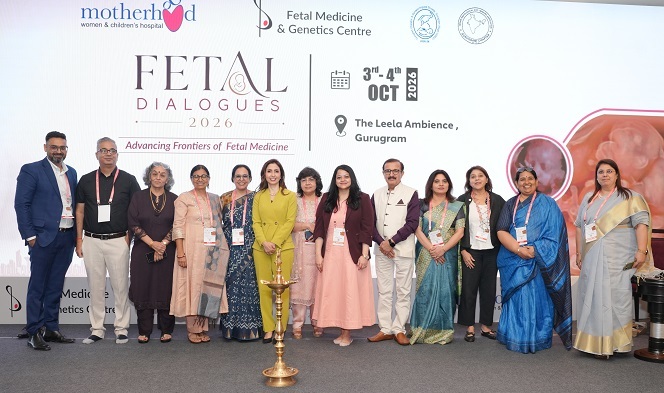
Motherhood Hospitals, in collaboration with Fetal Medicine & Genetics Centre, hosted Fetal Dialogues 2026 on October 3–4. The inaugural conference brought together leading fetal medicine and pregnancy-care specialists from across India to strengthen clinical skills, promote knowledge exchange and advance prenatal care. The two-day programme focused on emerging approaches in fetal medicine, prenatal diagnosis, genetics and high-risk pregnancy care, while providing healthcare professionals with opportunities to discuss complex cases and share practical clinical experiences.
Leading Fetal Medicine Experts Share Clinical Expertise
The conference brought together an eminent faculty, including Dr. Anita Kaul, Dr. Ratna Puri, Dr. Chanchal Singh, Dr. Siddhesh Pandey, Dr. Sandeep Yadav, Dr. Seema Thakur, Dr. Balu Vaidyanathan and Dr. Meenu Handa. Motherhood Hospitals specialists Dr. Preety Aggarwal, Dr. Shweta Wazir and Dr. Sanjay Wazir also participated, alongside UK-based Professor Asma Khalil and Dr. Shreyasi Sharma, Organizing Secretary, Fetal Dialogues 2026. Together, the experts shared insights spanning fetal medicine, genetics, obstetrics, pregnancy care and neonatal medicine, with a common focus on improving outcomes for unborn babies and supporting families throughout pregnancy.
Focus on Early Detection and Prenatal Assessment
Congenital conditions and developmental concerns can significantly affect newborn health. According to the World Health Organization, congenital disorders are among the causes of neonatal deaths globally. Against this backdrop, the conference highlighted the importance of timely pregnancy assessments, specialist counselling and coordinated prenatal care. Although prenatal tests cannot detect every condition, appropriate screening and diagnostic evaluation can identify certain concerns and help clinicians plan further investigations, treatment and follow-up. The discussions therefore emphasized not only early detection but also the importance of interpreting findings accurately and communicating them clearly to expectant parents.
Twin Pregnancies, Fetal Growth and Genetics Take Centre Stage
According to Dr. Shreyasi Sharma, Organizing Secretary, Fetal Dialogues 2026, the conference was designed around meaningful clinical dialogue and practical learning. “Fetal Dialogues upholds the true spirit of dialogue, where clinical wisdom is gathered, tested, challenged and passed on. We are having these dialogues for the unborn who are not yet able to speak for themselves.” She added that the two-day programme addressed twin and multiple pregnancies, fetal growth restriction, detailed assessment of the developing brain and heart, and advances in genetics. Through workshops, demonstrations and complex case discussions, participants explored how healthcare professionals can identify abnormalities earlier and make informed decisions throughout pregnancy.
Integrating Maternal and Fetal Health
Dr. Preety Aggarwal, Medical Director, Obstetrics and Gynecology, Motherhood Hospitals, Gurgaon, emphasized the importance of considering both maternal health and fetal development when planning pregnancy care. “The event reinforced that good pregnancy care begins with understanding both the mother’s health and the baby’s development. Advances in ultrasound and genetic assessment can help us recognize concerns earlier, but their value depends on careful interpretation and clear counselling.” She noted that the conference encouraged clinicians to review their decisions, exchange experiences and strengthen collaboration between obstetricians, fetal medicine specialists and newborn-care teams. As a result, families can benefit from clearer guidance, timely referrals and coordinated care throughout pregnancy, delivery and the postnatal period.
Strengthening Care for Complex and High-Risk Pregnancies
Dr. Shweta Wazir, Senior Consultant, Obstetrician and Gynecologist, Motherhood Hospitals, Gurgaon, highlighted the importance of looking beyond individual scan findings when managing complex pregnancies. She explained that when a fetus appears smaller than expected or complications arise in a twin pregnancy, doctors must assess growth patterns, blood flow and the mother’s clinical condition together. The practical workshops and case discussions helped participating doctors refine their approach to monitoring and delivery planning. At the same time, the sessions emphasized the importance of communicating uncertainty to parents clearly and compassionately. By combining evidence-based assessment with appropriate follow-up and specialist referrals, clinicians can develop care plans tailored to each pregnancy.
Connecting Prenatal Care with Newborn Care
Dr. Sanjay Wazir, Medical Director (NCR) – Neonatology, Motherhood Hospitals, Gurgaon, stressed that care for vulnerable newborns should begin before birth whenever prenatal concerns are identified. “The event highlighted how communication between obstetricians, fetal medicine specialists and neonatologists can help teams prepare for premature babies, babies with growth concerns and those with suspected developmental conditions.” Prenatal information can help medical teams determine the appropriate delivery setting, equipment and specialist support required at birth. It can also help families understand potential challenges and prepare for the newborn’s care needs. Therefore, stronger communication between prenatal and neonatal teams can support smoother transitions from pregnancy care to newborn care.
Building the Future of Prenatal Care
Fetal Dialogues 2026 concluded with a focus on translating advances in fetal medicine into practical, coordinated care for mothers and babies. Through expert-led workshops, clinical case discussions and knowledge-sharing sessions, the conference encouraged healthcare professionals to strengthen diagnostic skills, identify potential concerns earlier and collaborate across specialties. Importantly, the discussions went beyond identifying fetal risks. They also addressed how clinicians can explain findings to families, support informed decision-making and plan appropriate care before and after birth. As per the press release, the inaugural edition of Fetal Dialogues has therefore established a platform for continued learning and professional collaboration, with the broader goal of making prenatal care more informed, coordinated and responsive to the needs of every pregnancy.