





















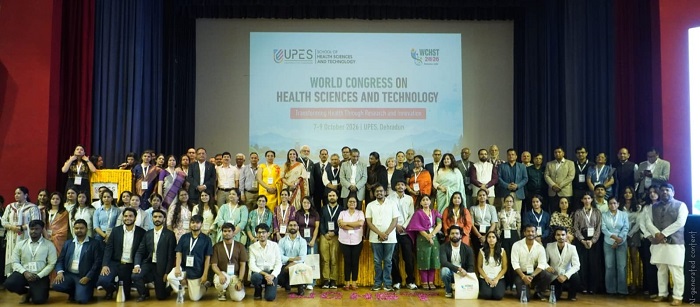
UPES inaugurated the World Congress on Health Sciences and Technology 2026 (WCHST 2026) at its Bidholi campus in Dehradun, bringing together researchers, clinicians, healthcare professionals, policymakers, innovators and industry leaders from India and abroad. Organised by the School of Health Sciences and Technology (SOHST), UPES, the three-day international congress is being held from 7 to 9 October 2026 under the theme “Transforming Health through Research and Innovation.” Led by Dr. Padma Venkat, Dean, SOHST, UPES, and Dr. Nidhi Chauhan, Professor and Organising Secretary, SOHST, the event is expected to attract more than 500 participants, including 9 international speakers and 18 eminent national speakers. The programme aims to strengthen scientific collaboration and explore technology-driven solutions to emerging healthcare challenges.
Distinguished Leaders Open WCHST 2026
The inaugural ceremony featured leading figures from healthcare, research, government and academia. Padma Shri Professor Balram Bhargava, Former Director General, Indian Council of Medical Research (ICMR), and Former Secretary, Department of Health Research, Government of India, attended as the Chief Guest. Dr. Sunil Rai, Vice Chancellor, UPES, was also present, while Dr. Soumya Swaminathan, Former Deputy Director-General of the World Health Organization, delivered the Presidential Address virtually. The gathering also included Padma Bhushan Professor Nirmal Kumar Ganguly, Former Director General, ICMR; Professor Bhushan Patwardhan, National Research Professor, Ministry of AYUSH; Padma Shri Professor N. Punniamurthy, Ethnoveterinary Herbal Medicine Consultant, TransDisciplinary University, Bengaluru; Dr. BVRC Purushottam, IAS, Secretary, Government of Uttarakhand; and Dr. Durgesh Pant, Director General, Uttarakhand State Council for Science and Technology (UCOST). International participation includes Professor Suresh Mittal of Purdue University, USA; Professor Can Dincer of the Technical University of Munich, Germany; and Dr. Ajeet Kumar Kaushik of Florida International University, USA.
Focus on Healthcare Research and Innovation
Padma Shri Professor Balram Bhargava highlighted the importance of strengthening research and innovation in healthcare. “The World Congress on Health Sciences and Technology provides an important platform to strengthen research and innovation in healthcare. India has to invest more in newer drugs, biosimilars and innovative pharma, and I believe this institute and its students can contribute significantly to that.” Meanwhile, Dr. Sunil Rai, Vice Chancellor, UPES, emphasized the university’s focus on technology-driven healthcare research. “At UPES, we have been focusing on research and innovation in health sciences for early detection of terminal diseases, by harnessing science, technology, innovation, biomarkers, AI, and genomics, as well as the possibility of creating low-cost medical diagnostic instruments, making healthcare more accessible and affordable.” He added that WCHST 2026 can connect scientific research with technology, clinical expertise, industry and policy while encouraging international collaborations that translate promising ideas into practical healthcare solutions.
Multidisciplinary Programme Covers Emerging Healthcare Technologies
The scientific programme reflects the multidisciplinary nature of modern healthcare. It covers areas including:
Biotechnology and molecular biology
Genomics and precision medicine
Microbiology and pharmaceutical sciences
Biomedical engineering
Artificial intelligence in healthcare
Digital health
Public health
Regenerative medicine
Translational medicine
Through keynote lectures, panel discussions, research presentations, poster sessions and industry interactions, the Congress aims to encourage cross-disciplinary collaboration and accelerate the translation of scientific discoveries into healthcare applications.
Global and Industry Participation Strengthens Collaboration
WCHST 2026 has brought together experts from leading global and Indian institutions, including Purdue University, Technical University of Munich, Florida International University, King Abdullah University of Science and Technology, AIIMS, IIT Roorkee, IIT Gandhinagar, CSIR-Central Food Technological Research Institute and CSIR-Institute of Genomics and Integrative Biology. The Congress also features experts associated with IBM India, Jubilant Biosys, CuraTeQ Biologics and Operon Technologies. Their participation is helping strengthen interaction between academia, healthcare, technology and industry.
Panel Explores Wellness and Preventive Healthcare
The inaugural day featured a panel discussion titled “Nourish to Flourish – The Wellness Blueprint: Shaping a Healthier Future.” Moderated by Dr. Nidhi Kumar, Celebrity Lead Anchor, DD, AI, the session brought together Dr. Jayanti Singh, Epidemiologist and Public Health Expert; Shri G.C. Kandwal, Deputy Commissioner, FDA, Uttarakhand; Mr. Sukhwinder Singh, HOD, FSSAI, UT Administration, Chandigarh; Ms. Rajat Shakti, Station Head, Red FM 93.5; Ms. Roopa Soni, Nutritionist; and Ms. Ashu Jain, PhD, IIT-D, Hybrid Athlete and Health Influencer. The discussion focused on wellness, nutrition, food regulation and preventive healthcare, highlighting the importance of proactive approaches to health.
Ayurveda and Modern Science Take Centre Stage
The afternoon sessions explored the relationship between traditional healthcare knowledge and modern scientific research. The “Veda to Village: Science, Policy and Practice for Holistic Wellbeing” session opened with a keynote by Prof. Dr. G.G. Gangadharan, Ayurvedacharya and Chief Physician, Ayurvedamritham Health Centre, Bengaluru. His session focused on the Ayurveda-based approach to month-wise care of expectant mothers. This was followed by a lecture from Prof. N. Punniamurthy on translational research in ethnoveterinary medicine and its relevance to the broader One Health approach. Dr. Bhavna Prasher, Senior Principal Scientist, CSIR-IGIB, examined the intersection of traditional knowledge and modern genomics through her session on Ayurgenomics and precision healthcare.
Experts Discuss the Contemporary Role of Ayurveda
A separate panel titled “Relevance of Ayurveda in Today’s Life” examined how Ayurveda can contribute to evolving approaches to health and wellbeing. Moderated by Vd. Shikha Prakash, Padaav – Specialty Ayurvedic Treatment Center, Dehradun, the panel included Prof. Dr. G.G. Gangadharan, Dr. Rajeev Kurele, Dr. Bhavna Prasher and Ms. Surabhi Pandey of The Hans Foundation. The discussion explored the contemporary application of Ayurveda and its potential role within integrated and preventive healthcare models.
Focus Shifts from Treatment to Prevention
The first day concluded with a panel titled “From Hospitals to Healthy Communities: Who is Responsible for Prevention?” Moderated by Dr. Rai Ganguly, SoLSH, the session featured Dr. Alex Thomas, Lifestyle Medicine Physician; Prof. Padma Venkat; Dr. Pranjali, Psychology Expert; and Dr. Monika Pathania, Lifestyle Medicine, Integrative Medicine and Holistic Wellness Expert. The panel brought together perspectives from lifestyle medicine, public health, psychology and integrative healthcare. Consequently, the discussion emphasized the need to move beyond treatment and strengthen prevention-focused healthcare.
Pre-Conference Workshops Showcase Emerging Technologies
In addition to the main Congress, UPES organised five specialised pre-conference workshops covering healthcare entrepreneurship, Space Tech for Health, advanced microscopy, next-generation point-of-care diagnostics and technologies for human microbiome research. A Scientific and Technology Exhibition is also showcasing research prototypes, diagnostic technologies, laboratory solutions and healthcare innovations from academic institutions, research organisations, startups and industry partners.
WCHST 2026 to Continue with Innovation and Collaboration
The World Congress on Health Sciences and Technology will continue on 8 and 9 October, featuring further keynote addresses, scientific presentations, panel discussions and industry interactions. The programme will also include the SYNAPSE Student Innovation Forum, creating additional opportunities for young researchers and innovators to present ideas and build collaborations. As per the press release, with its strong mix of health sciences, emerging technologies, clinical expertise, research and industry participation, WCHST 2026 aims to create a collaborative platform that can accelerate healthcare innovation and translate research into solutions with meaningful impact on patients and communities.