



















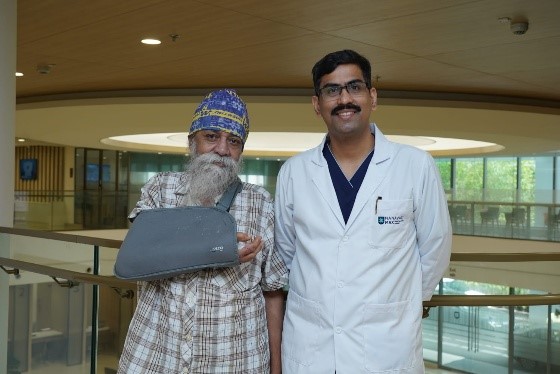
Doctors at Nanavati Max Super Speciality Hospital, Mumbai, successfully replanted the completely amputated thumb of a 69-year-old taxi driver following an eight-hour microsurgical procedure. The complex surgery restored blood circulation to the thumb and helped preserve the patient’s hand function after a serious lift-door accident. The timely preservation of the amputated thumb and rapid transfer to a specialised microsurgical centre played a crucial role in the successful outcome.
Severe Thumb Injury in Lift Accident
Ahinderpal Singh Alag, a 69-year-old taxi driver from Sion, Mumbai, suffered a severe hand injury when his hand became trapped in a lift door as the lift began moving. The accident caused an extensive avulsion injury, in which the thumb’s skin, soft tissue, muscles, tendons, ligaments and bone were forcibly separated from their normal attachments. Unlike a clean-cut amputation, an avulsion injury can cause extensive damage to blood vessels and surrounding tissues, making surgical reconstruction particularly challenging. Following the accident, Alag’s family acted quickly to preserve the amputated thumb. They wrapped it in moist gauze, placed it inside a plastic bag and kept it cooled with ice before taking him for initial medical care. He was subsequently brought to Nanavati Max Hospital for specialised treatment.
Microsurgery Begins Without Delay
Because successful replantation depends heavily on timely intervention, a team led by Dr Bharat Saxena, Principal Consultant, Centre for Plastic, Aesthetic and Reconstructive Surgery, Nanavati Max Super Speciality Hospital, immediately assessed the patient. The surgical team then began revascularisation, a procedure aimed at restoring blood flow to the amputated thumb. The
eight-hour operation involved several stages of microsurgical reconstruction. First, surgeons stabilised the amputated thumb. They then repaired the arteries and veins and meticulously reconnected the nerves, tendons and muscles. Using a high-powered operating microscope, the team also reconnected the tiny blood vessels required to restore circulation. Finally, surgeons reconstructed the skin and surrounding soft-tissue coverage.
Why the Surgery Was Particularly Challenging
The injury presented an additional challenge because it involved avulsion rather than a straightforward amputation. In an avulsion injury, tissues and blood vessels can be stretched, torn and damaged over a wider area. Therefore, identifying and repairing viable vessels requires greater precision and microsurgical expertise. Despite these challenges, the surgical team successfully restored blood flow and preserved the replanted thumb.
Thumb Remains Viable After Surgery
The patient’s recovery progressed well following the procedure. He was discharged within a week, and the replanted thumb remained completely viable. His wounds healed without infection or significant tissue loss. Doctors also observed early movement in the thumb, while the patient began physiotherapy to progressively regain function and mobility.
Why Thumb Replantation Matters
Dr Saxena highlighted the importance of the thumb in everyday hand function. The thumb enables people to grip, grasp and oppose their fingers. Consequently, losing the thumb can severely affect routine activities and may have a major impact on the ability of working individuals to return to their jobs. “Correct preservation of an amputated part and timely referral to a centre with microsurgical expertise can significantly influence the possibility of successful replantation,” Dr Saxena said. He added that, whenever medically feasible, doctors should consider upper-limb replantation, as preserving a patient’s own body part can provide significant functional benefits.
Proper Preservation Can Improve Replantation Outcomes
The case also highlights the importance of what happens immediately after an amputation. Keeping an amputated body part appropriately protected and cooled can help preserve the tissue until specialist treatment is available. However, the amputated part should not be placed directly on ice, as direct contact can damage the tissue. Rapid transportation to a medical centre with microsurgical replantation expertise is equally important because the viability of amputated tissue depends on factors such as the injury, blood-vessel damage and time without adequate blood supply.
Multidisciplinary Care Supports Recovery
The successful outcome involved coordinated efforts from multiple teams at Nanavati Max Super Speciality Hospital. Specialists from the Centre for Plastic, Aesthetic & Reconstructive Surgery, Anaesthesia, Critical Care, Nursing, Physiotherapy and Rehabilitation departments worked together throughout the emergency treatment and recovery process. As per the press release, the case demonstrates how timely first aid, proper preservation of an amputated part, advanced microsurgery and structured rehabilitation can work together to improve outcomes following severe traumatic amputations.