






















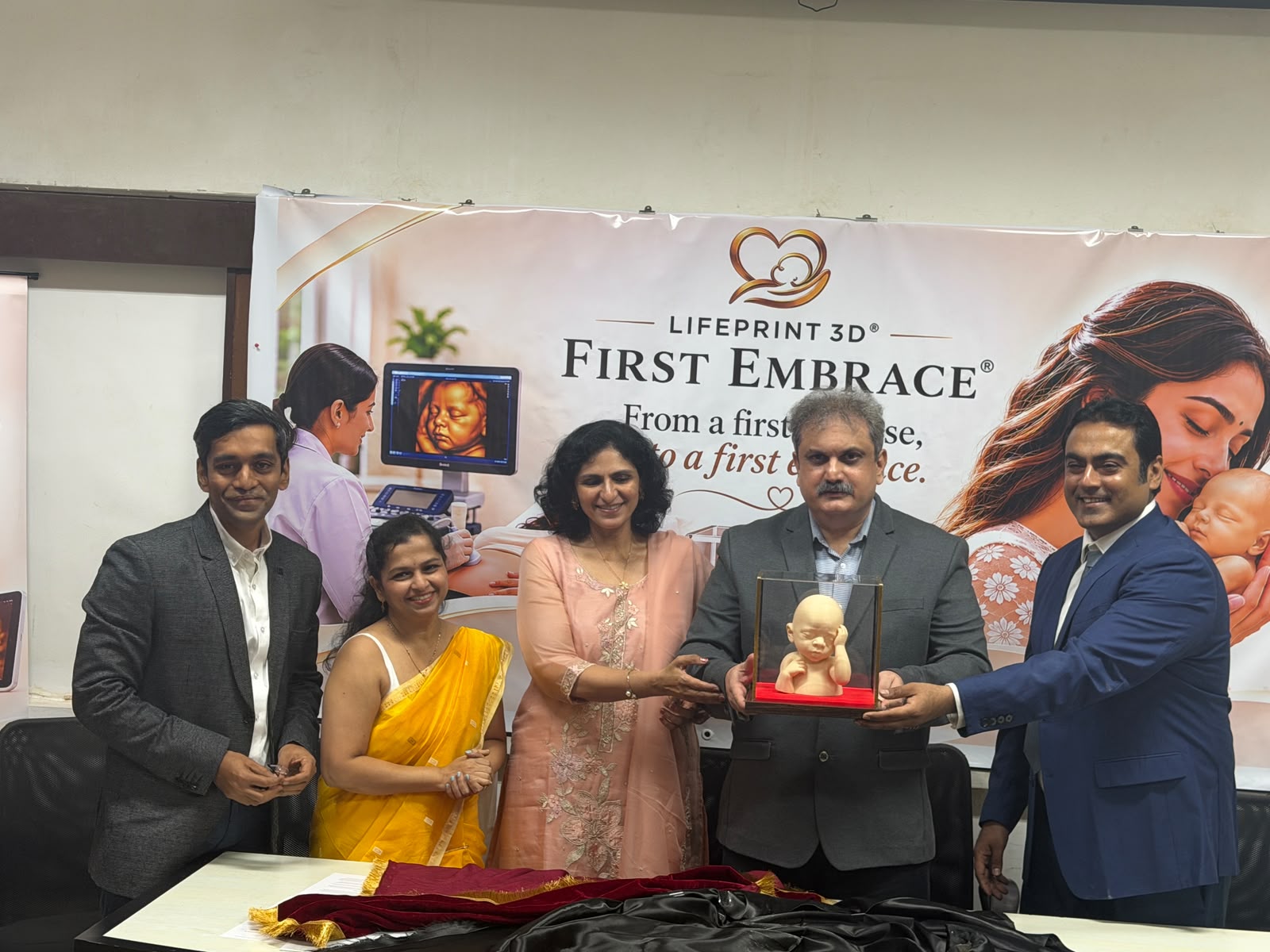
The new service converts existing 3D and 4D ultrasound scans into personalised 3D-printed models, while the company explores wider applications of 3D medical imaging.
Mumbai: Medical imaging has transformed healthcare by allowing doctors to examine the human body through ultrasound, CT and MRI scans. Now, LifePrint 3D is taking this technology a step further by converting digital medical images into physical three-dimensional models.
The Mumbai-based medical technology venture, co-founded by radiologists Dr. Anand Bherwani, Dr. Sandesh Rothe and Dr. Sheetal Kabra, has launched FirstEmbrace, a service that transforms existing 3D and 4D ultrasound scans into personalised 3D-printed keepsakes of an unborn baby’s face and upper body.
FirstEmbrace Converts Ultrasound Images into 3D Keepsakes
The service allows expectant parents to preserve a visual memory of their unborn baby in a tangible format. Using advanced image processing, artificial intelligence and 3D printing, the technology converts suitable ultrasound images into physical models that families can hold and cherish.
Unlike conventional image printing, however, converting ultrasound data into a three-dimensional model involves several technical challenges, including image noise, shadows, fetal movements and variations in scan quality.
Dr. Sandesh Rothe, Radiologist, Co-founder and Partner at LifePrint 3D, said the service aims to help parents preserve special pregnancy memories without encouraging unnecessary ultrasound examinations. The company uses scans already performed as part of routine medical care, subject to image quality and the treating doctor’s discretion.
Dr. Sheetal Kabra explained that every ultrasound scan presents different challenges depending on the baby’s position, surrounding structures and image quality. She emphasised that accurate reconstruction requires careful assessment and image processing to preserve the visible features captured in the original scan.
Research Highlights Emotional Benefits of 3D-Printed Models
The potential of this technology also finds support in published research. A 2020 randomised controlled study involving 96 expectant mothers, published in the Journal of Obstetric, Gynecologic & Neonatal Nursing, found greater improvements in maternal-fetal attachment scores among women who received 3D-printed models of their unborn babies compared with those who received ultrasound images alone.
The average improvement was 8.7 points in the 3D-model group, compared with 4.9 points in the ultrasound-only group. These findings suggest that physical representations may add an emotional dimension to the pregnancy experience.
LifePrint 3D Explores Wider Applications in Medical Imaging
Beyond pregnancy keepsakes, LifePrint 3D is developing physical anatomical models using suitable CT and MRI datasets. These include models of the heart, lungs, liver, kidneys, brain, spine, bones and vascular structures.
Such models could help doctors explain complex anatomy, support medical education and improve communication between healthcare professionals and patients.
Dr. Anand Bherwani, Radiologist, Co-founder and Partner at LifePrint 3D, said the company aims to combine artificial intelligence and advanced computational technologies to make three-dimensional anatomical models more accessible. Its current anatomical modelling work focuses on education, demonstrations and patient communication.
FirstEmbrace to Be Available Across India
LifePrint 3D plans to make FirstEmbrace available across India through ultrasound clinics and hospitals, as well as directly to families through its website, www.lifeprint3d.com. The company also plans to offer doorstep delivery, with pricing aimed at making the service accessible to middle-income Indian families.
Regulatory and Ethical Considerations
FirstEmbrace is a non-medical, non-diagnostic keepsake and does not replace medical imaging, clinical reports or professional medical interpretation. The models are intended solely to preserve a visual memory and cannot be used for medical assessment or treatment decisions.
Additionally, the service is restricted to the baby’s face and upper body. It does not determine or reveal the sex of the foetus and will operate in accordance with the Pre-Conception and Pre-Natal Diagnostic Techniques (Prohibition of Sex Selection) Act, 1994. As per the company press release, LifePrint 3D aims to expand the use of 3D printing in medical imaging, making anatomical models more accessible for families, medical education and patient communication.