




















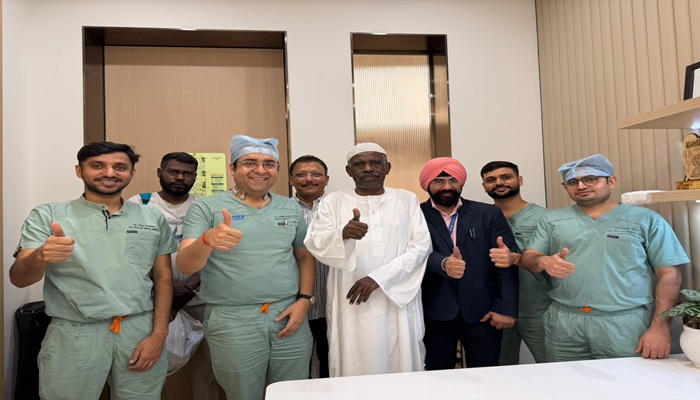
Max Smart Super Speciality Hospital, Saket, successfully performed advanced robotic bladder cancer surgery on a 68-year-old Sudanese Army General, who travelled to India for specialised treatment. The patient, diagnosed with muscle-invasive bladder cancer, underwent robot-assisted removal of the urinary bladder and prostate, along with nearby pelvic lymph nodes, followed by urinary reconstruction using a segment of the small intestine.
Patient Travels to India for Specialised Cancer Treatment
The patient, Mr. Yhya Mohammed Khair Ahmed, was initially diagnosed with bladder cancer in Sudan. He experienced intermittent blood in his urine for two months, accompanied by a burning sensation during urination. Subsequently, he travelled to India for further evaluation and specialised surgical care.
At Max Smart Super Speciality Hospital, a medical team led by Dr. Tushar Aditya Narain, Director – Urological Oncology and Robotic Surgery, conducted a comprehensive assessment to determine the extent of the cancer. Based on the findings, the doctors recommended surgery to remove the urinary bladder, prostate and nearby pelvic lymph nodes to assess the spread of the disease.
Robotic Surgery Enables Minimally Invasive Reconstruction
The surgical team used the da Vinci Xi robotic surgical system to perform the procedure. During surgery, the doctors also identified enlarged lymph nodes in the pelvic region and removed them from both sides.
Following bladder removal, the team reconstructed the urinary drainage pathway using a 15 cm segment of the patient’s ileum, the final part of the small intestine. This technique, known as an ileal conduit, allows urine to drain into an external collection bag.
Notably, the surgeons performed the urinary reconstruction entirely inside the body with robotic assistance, avoiding the need for a large abdominal incision for this part of the procedure. The robotic approach enabled the team to undertake both bladder removal and urinary reconstruction through minimally invasive techniques.
Patient Recovers and Returns Home
Commenting on the procedure, Dr. Tushar Aditya Narain, Director – Urological Oncology and Robotic Surgery, Max Smart Super Speciality Hospital, Saket, said that bladder cancer surgery is complex because it involves removing the urinary bladder and creating an alternative route for urine drainage.
He explained that the medical team’s objective was to perform both the removal and reconstruction using a minimally invasive robotic approach. The da Vinci Xi system helped the surgeons carry out the procedure with precision and complete the urinary reconstruction inside the body, avoiding a large abdominal incision for this stage of surgery.
The patient recovered well and was discharged in a stable condition after one week. He returned home with a urine drainage bag and instructions for postoperative care and continued medical follow-up.
The case highlights the expanding role of robotic-assisted surgery in treating complex urological cancers. It also demonstrates how minimally invasive surgical techniques can support complex procedures involving bladder removal and urinary reconstruction. As per the company press release, the successful treatment also reflects India’s growing appeal as a destination for advanced medical care, providing international patients access to specialised cancer treatment and continued follow-up.