





















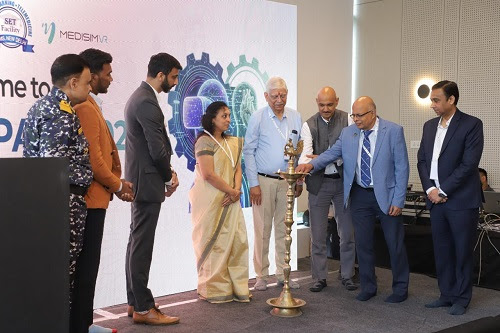
SIMPACT 2026, a national symposium focusing on the future of healthcare training and competency-based education, brought together leading experts in New Delhi. The event was organised through a collaboration between the Healthcare Sector Skill Council (HSSC), the SET Facility at AIIMS Delhi, and MediSim VR.
The symposium convened healthcare educators, policymakers, clinicians, and simulation specialists to discuss how simulation-based training, artificial intelligence (AI), and virtual reality (VR) can strengthen clinical competency and prepare India’s healthcare workforce for evolving challenges.
Focus on Simulation and Immersive Technologies
Hosted at the Healthcare Sector Skill Council in New Delhi, the event featured keynote sessions, panel discussions, and demonstrations of immersive simulation technologies. Participants also experienced a VR-based training environment at the Advanced Technology Centre (ATC) Lab, which showcased how immersive platforms can support clinical skill development in controlled and repeatable settings.
Through these demonstrations, the symposium highlighted the growing role of AI-enabled simulation tools in modern medical education and workforce training.
Participation of Distinguished Healthcare Leaders
SIMPACT 2026 was attended by several prominent leaders from India’s healthcare and academic sectors. The event’s chief guests included Dr. Ambuj Roy, Professor of Cardiology and Head of the SET Facility at AIIMS Delhi, and Dr. V N Mahalakshmi, Vice Chancellor of Santosh Deemed-to-be-University.
Additionally, Dr. Manish Honwad, Surgeon Rear Admiral, VSM, and Commanding Officer at INHS Asvini, attended as the Guest of Honor and shared insights on expanding healthcare skill training across both civilian and defence healthcare systems.
Expert Speakers and Panel Discussions
The symposium featured a distinguished lineup of speakers, including Ashish Jain, CEO of the Healthcare Sector Skill Council; Dr. Rashmi Ramachandran, Professor in the Department of Anaesthesiology, Pain Medicine and Critical Care at AIIMS Delhi; Dr. Dinker Pai, Director of the Medical Simulation Centre and Professor of Surgery at Mahatma Gandhi Medical College and Research Centre; and Dr. Adith Chinnaswami, Organising Secretary of SIMPACT 2026 and Co-founder and COO of MediSim VR.
The panel discussions included contributions from several healthcare and nursing education experts, such as Dr. Rajesh Kumar Sharma, Dr. Lekha Viswanath, Col. Binu Sharma, Dr. Anu Gauba, Ms. Ekta Malik, Ms. Robia Chacko, Ms. Anshu Verma, and Mr. Unnikrishnan.
Key Themes in Healthcare Training
During the discussions, experts focused on three key themes shaping the future of healthcare education in India. First, they examined how simulation can support Competency-Based Medical and Nursing Education (CBME). Second, they addressed the gap between simulation infrastructure and measurable learning outcomes. Finally, they explored strategies to scale advanced simulation technologies to meet the demands of India’s growing healthcare workforce.
Role of Simulation in Clinical Training
Experts emphasised that simulation-based learning is becoming an essential component of modern clinical training. AI-enabled immersive platforms allow healthcare professionals to practice procedures, refine clinical decision-making, and manage complex scenarios in safe, standardised environments. Consequently, these technologies reduce patient risk while improving clinical preparedness.
Ashish Jain, CEO of the Healthcare Sector Skill Council, highlighted the importance of technology in workforce development. He noted that as India expands healthcare delivery systems, simulation and immersive technologies offer scalable solutions to strengthen training standards and workforce readiness.
Similarly, Dr. Ambuj Roy emphasised the importance of simulation in high-acuity medical disciplines, noting that it allows clinicians to rehearse complex procedures and emergency scenarios without risking patient safety.
Importance of Immersive Learning Platforms
Dr. V N Mahalakshmi, Vice Chancellor of Santosh Deemed-to-be University, stated that simulation does not replace clinical exposure but helps healthcare professionals learn and refine skills in a zero-risk environment.
Meanwhile, Dr. Manish Honwad highlighted the importance of simulation in defence healthcare training, where professionals must prepare for high-risk situations with no margin for error. Integrating technologies such as virtual reality into medical education, he noted, improves confidence and readiness among healthcare professionals.
In addition, Dr. Adith Chinnaswami emphasised that immersive technologies help bridge the gap between theoretical learning and clinical practice. VR-based training platforms allow learners to repeatedly practice procedures and decision-making until they achieve competency.
Strengthening Collaboration in Healthcare Education
Overall, SIMPACT 2026 reflected a growing national movement to strengthen collaboration between academia, industry, and sector skill bodies. By promoting simulation-based healthcare education, such initiatives aim to build a future-ready healthcare workforce in India.