





















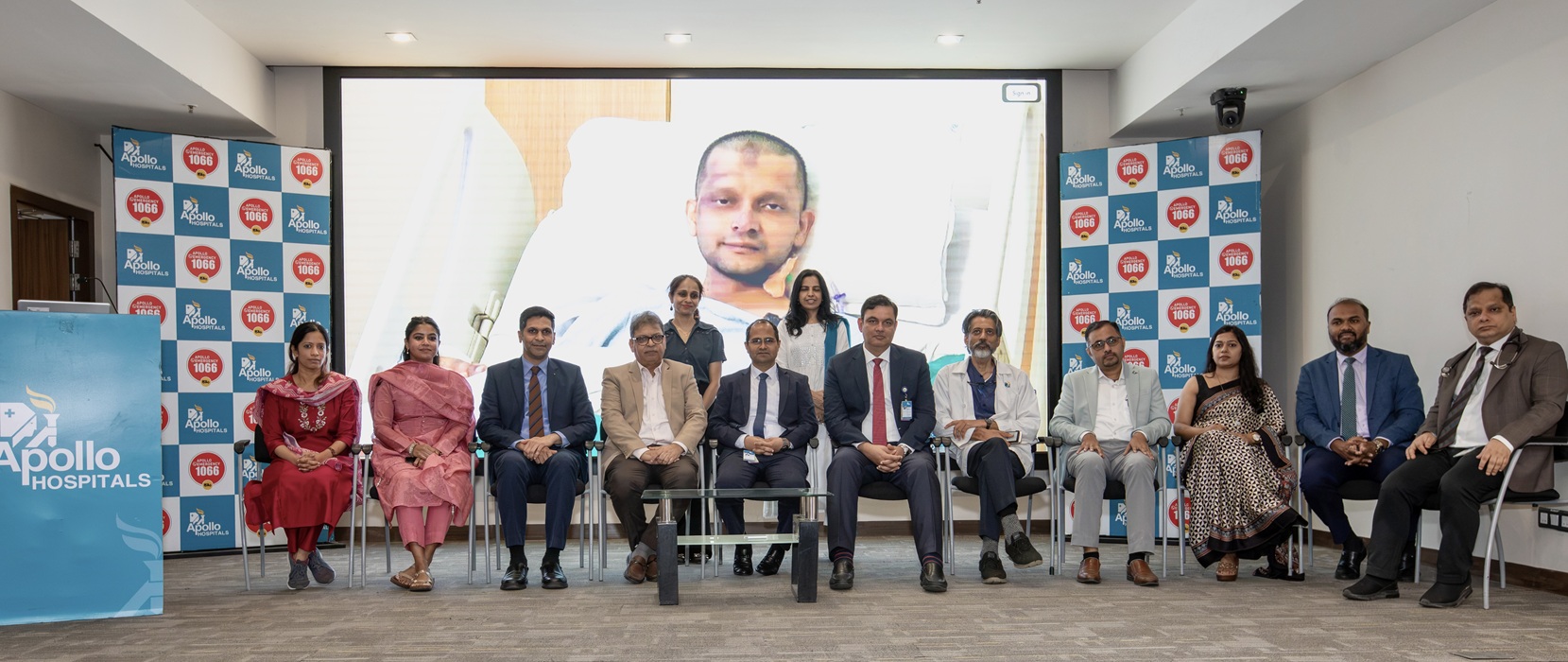
A 37-year-old ranking officer has made a remarkable recovery after surviving what doctors at Apollo Hospitals Navi Mumbai describe as one of the most complex polytrauma cases they have ever managed. The patient sustained multiple fractures, a crushed and pulseless right upper limb, and a traumatic rupture of the aorta—the body’s main blood vessel—a combination of injuries that could have proved fatal within minutes.
Patient Reaches Apollo in Critical Condition
Initially, the patient was taken to another hospital before being referred to Apollo Hospitals Navi Mumbai. He arrived in a critical condition with dangerously low blood pressure and life-threatening injuries. Recognising the urgency, the medical team decided not to delay treatment for financial formalities. Consequently, they shifted him to the operation theatre within 45 minutes of his arrival in the Emergency Department.
Multiple Specialist Teams Work Simultaneously
Upon examination, the trauma team led by Dr Nitin Jagasia, Regional Director, Emergency Medical Services, Apollo Hospitals, Western Region, identified multiple fractures involving the pelvis, femur, both arms and thigh region. The patient’s right forearm had been severely crushed, with no palpable pulse, making limb salvage a major challenge.
Additionally, a CT Aortogram revealed a traumatic rupture of the aorta caused by the severe deceleration force of the accident, one of the most life-threatening injuries in trauma care.
A team of three orthopaedic surgeons, including Dr Sameer Chaudhari, Consultant Trauma, Orthopaedic & Joint Replacement Surgeon, Apollo Hospitals Navi Mumbai, spent nearly two-and-a-half hours stabilising the fractures and controlling pelvic instability. At the same time, Dr Charudatta Chaudhari, Consultant Plastic and Reconstructive Surgeon, and his team worked to salvage the crushed forearm. Simultaneously, the cardiovascular team led by Dr Brajesh Kumar Kunwar, Head of the Cardiology Department, prepared for an emergency aortic repair by arranging the precise stent size even before the patient reached the cath lab.
Intensive Care and Staged Recovery
The patient remained on ventilator support in the Intensive Care Unit for approximately one week. During this period, he also developed kidney-related complications, which the medical team treated successfully.
Subsequently, the focus shifted to advanced wound management using vacuum-assisted closure (VAC) therapy, frequent dressing changes, internal fixation surgeries for the pelvis and femur, and plastic surgery for soft-tissue reconstruction and wound coverage.
As per the press release, more than 50 doctors, nurses and caregivers from multiple specialties coordinated every stage of treatment, ensuring seamless care from emergency intervention to rehabilitation.
Rehabilitation Marks a Significant Milestone
By the third week, the patient had recovered sufficiently to move from the ICU to the general ward, where the physiotherapy team initiated rehabilitation. Around six weeks after the injury, he was discharged while using a wheelchair. Within seven weeks, he had begun attempting to stand, and he continues physiotherapy as he progresses toward a full recovery.
Expert Speak
Commenting on the case, Dr Sameer Chaudhari said:
“This was one of the most challenging polytrauma cases we have managed. The patient arrived with multiple fractures, pelvic instability and a severely crushed right upper limb with no palpable pulse, making limb salvage a major concern. In trauma care, time is critical, and every decision has to be made swiftly and precisely. Throughout the treatment, multiple specialties worked in close coordination to stabilise the fractures, preserve limb function and support the patient’s recovery. Seeing him progress from a near-fatal condition to regaining mobility has been immensely gratifying and highlights the importance of timely intervention and multidisciplinary teamwork.”
Reflecting on the patient’s recovery, Dr Kiran Shingote, COO & Unit Head, Apollo Hospitals Navi Mumbai, said:
“This case is a powerful example of what coordinated, multidisciplinary care can achieve. The coming together of more than 50 doctors, nurses and caregivers across specialties, supported by advanced infrastructure and round-the-clock expertise, transformed a near-fatal trauma into a story of hope and recovery. Such outcomes reaffirm our commitment to delivering world-class care when it matters most.”
The case underscores how rapid emergency response, multidisciplinary collaboration and advanced trauma care can significantly improve outcomes, even in the most critical medical emergencies.