















A 49-year-old cancer survivor who experienced severe facial deformity following cancer treatment has undergone complex jaw reconstruction using a customised, 3D-designed titanium implant. The procedure aimed to restore his facial structure and improve essential functions such as eating, speaking and swallowing. A multidisciplinary team led by Dr. Amit Chakraborty, Lead Head & Neck Surgical Oncologist at SSO Cancer Hospitals, Mumbai, performed the reconstruction using 3D virtual surgical planning, a patient-specific titanium implant and a left free anterolateral thigh (ALT) flap. This advanced approach helped the team address the complex facial defect and support the patient’s functional rehabilitation.
Cancer Treatment Leads to Complex Jaw and Facial Deformity
The patient was diagnosed with Stage III carcinoma of the right buccal mucosa—the inner lining of the right cheek—in March 2024. He subsequently underwent extensive cancer surgery followed by multimodality treatment. However, he later developed a postoperative oronasal fistula, an abnormal opening between the mouth and nose. This condition caused nasal regurgitation, in which food or liquids pass into the nose. He also developed a major defect affecting his jaw and facial structure. As a result, the patient experienced difficulties with eating, speaking and swallowing. The changes to his facial appearance also affected his quality of life, making reconstructive surgery an important step towards functional recovery.
PET-CT Confirms Disease-Free Status Before Reconstruction
Before proceeding with reconstruction, the medical team evaluated the patient’s cancer status. A PET-CT scan confirmed that he was disease-free at the time of assessment and showed no evidence of recurrence or metastasis. This allowed the team to focus on reconstructive rehabilitation.
Dr. Amit Chakraborty, Lead Head & Neck Surgical Oncologist at SSO Cancer Hospitals, Mumbai, said, “A PET-CT confirmed his current disease-free status and ruled out recurrence or metastasis, allowing the medical team to focus on complex reconstructive rehabilitation. Without reconstruction, the persistent oronasal fistula could have resulted in worsening nasal regurgitation, compromised mastication and swallowing, nutritional deterioration, progressive facial disfigurement and a substantial decline in quality of life.
“The reconstructive objective was therefore not simply to replace the missing jaw, but to restore facial architecture, symmetry, oral competence, mastication, speech, swallowing and appearance, helping the patient regain functional independence and confidence,” Dr. Chakraborty added.
3D Virtual Surgical Planning Enables Precise Jaw Reconstruction
The procedure presented several challenges because the patient had previously undergone surgery and radiotherapy. Severe radiation fibrosis, scarred and distorted tissue planes, restricted mouth opening and potentially compromised recipient blood vessels made reconstruction particularly demanding. To address these complexities, the surgical team used 3D virtual surgical planning to assess the defect, evaluate facial asymmetry and determine the desired reconstructive contour before surgery.
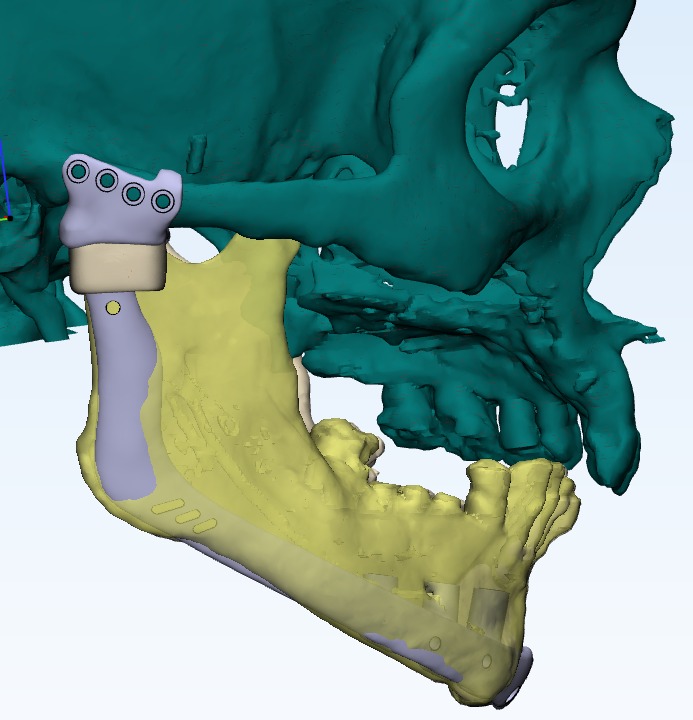
Using the patient’s CT-derived DICOM data, the team digitally designed a customised, biocompatible titanium implant to recreate his individual mandibulofacial anatomy. This patient-specific approach helped the surgeons plan the reconstruction with greater anatomical precision and predictability. The team combined the titanium implant with a left free anterolateral thigh flap, which provided vascularised soft tissue to cover and support the reconstructed area. The customised implant was prepared four days before surgery, allowing the team to plan the procedure in advance.
Why a Customised Titanium Implant Was Important
Traditional reconstruction of complex jaw defects can require substantial intraoperative estimation and manual implant shaping. In contrast, 3D virtual planning allows surgeons to study the patient’s anatomy and plan the desired jaw contour before entering the operating theatre.
Dr. Chakraborty explained, “This was an exceptionally demanding secondary reconstruction because the patient had previously undergone oncological surgery and radiotherapy, leaving severe fibrosis, scarred and distorted tissue planes, restricted mouth opening and potentially compromised recipient vessels. The objective was not merely to replace the missing portion of the jaw, but to restore the mandibular framework, facial contour, symmetry, and soft-tissue volume, while improving oral competence, mastication, speech, and swallowing.
“In such complex secondary defects, conventional reconstruction can be challenging because it relies more heavily on intraoperative estimation and manual bending. Three-dimensional virtual surgical planning allowed us to analyse the patient’s native craniofacial anatomy and contralateral symmetry before surgery and digitally recreate the desired facial projection and contour. A customised titanium patient-specific implant was then designed from his CT data to achieve greater anatomical accuracy, predictability and reproducibility during reconstruction.”
Surgery and Postoperative Recovery
The surgical team combined the customised titanium implant with the free ALT flap to provide soft-tissue coverage. According to the treating team, the procedure was completed uneventfully despite the challenges posed by previous radiation, fibrosis, altered tissue planes, restricted mouth opening and changes in the recipient vessels. Following surgery, the patient continued feeding through a Ryle’s tube for approximately two weeks. This approach helped protect the intraoral reconstruction, minimise stress on the suture line and support tissue healing.
The patient was discharged on 30 August 2026. He is now undergoing structured follow-up and oncological and reconstructive surveillance. His rehabilitation will focus on progressively improving chewing, speech and swallowing, with the broader goal of helping him regain functional independence and resume everyday activities.
Dr. Chakraborty further said, “The patient-specific titanium implant was combined with a left free anterolateral thigh flap to provide vascularised soft-tissue coverage. The procedure was completed uneventfully, although the reconstruction required meticulous planning because of the previous radiation, fibrosis, altered tissue planes, limited mouth opening and changes in the recipient vessels.
“Postoperatively, Ryle’s tube feeding was continued for approximately two weeks to protect the intraoral reconstruction, minimise stress on the suture line and support optimal tissue healing. The patient was discharged on 30 August 2026 and is now undergoing structured follow-up at one week, two weeks, one month and thereafter under oncological and reconstructive surveillance. Rehabilitation will focus on progressively improving mastication, speech and swallowing and helping him return towards functional independence and normal daily activities.”
Advanced Reconstruction Supports Recovery After Head and Neck Cancer
As per the press release, modern head and neck cancer care extends beyond removing a tumour. Reconstructive procedures can also help patients address the physical and functional challenges that follow cancer surgery and radiotherapy. In this case, the combination of 3D virtual surgical planning, a customised titanium implant and microsurgical soft-tissue reconstruction enabled the team to address a complex jaw and facial defect. The approach aimed to restore facial structure while supporting improvements in essential functions, confidence and independence.
Dr. Chakraborty concluded, “In modern head and neck cancer care, removing the cancer is only the first step. True recovery also means helping the patient regain essential functions such as eating, speaking and swallowing, while restoring facial appearance, confidence and independence. In this case, the use of 3D virtual planning, a customised titanium implant and microsurgical reconstruction allowed us to rebuild the jaw and facial structure with greater precision, helping the patient move towards a better quality of life and return to everyday activities with dignity.”