




















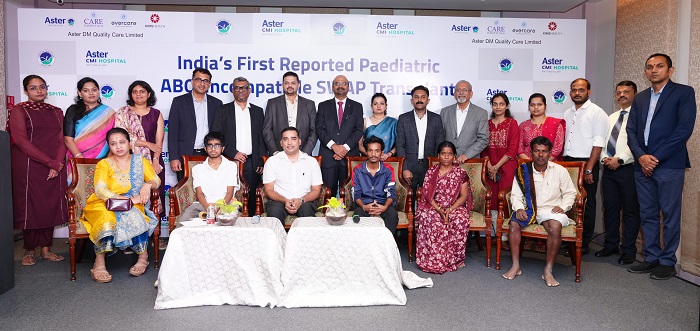
Aster CMI Hospital, Bengaluru, reported a significant milestone in kidney transplantation by facilitating a two-way kidney donor swap between two families, enabling a 15-year-old boy and a 21-year-old man to receive life-saving kidney transplants. According to the hospital, this is India’s first reported paediatric kidney transplant involving a donor exchange to overcome blood group incompatibility. Both patients had family members willing to donate a kidney. However, blood group incompatibility prevented the donors from donating directly to their intended recipients. To overcome this challenge, the hospital facilitated a kidney-paired donation (KPD), allowing the two families to exchange donors so that each patient could receive a more suitable kidney. The procedure highlights how advanced donor-matching technology and coordinated transplant care can expand opportunities for patients who cannot undergo direct living-donor transplantation.
Donor-Matching Technology Enables a Two-Way Kidney Swap
Aster CMI Hospital used donor-matching software from the Alliance for Paired Donation (APD) to identify suitable donor-recipient combinations for the exchange. Through this approach, the teenager received a kidney from the donor associated with the 21-year-old patient’s family, while the adult patient received a kidney from the teenager’s family donor. This exchange enabled both patients to proceed with transplantation despite the incompatibility that had prevented direct donation. Kidney-paired donation is an established transplant strategy that connects incompatible donor-recipient pairs with other pairs whose donors may be better suited to their intended recipients. Depending on the circumstances, this approach can help address blood group or human leukocyte antigen (HLA) incompatibility. By evaluating donor-recipient pairs systematically, matching software can help transplant teams identify suitable exchanges and improve access to living-donor kidneys. However, every proposed match still requires detailed medical evaluation to establish compatibility and minimise risks.
Months of Planning and Coordinated Surgical Care
The two-family kidney swap required months of planning, detailed coordination and collaboration among multiple medical specialties. According to the hospital, the complex procedure involved four operating theatres functioning simultaneously, supported by four anaesthetists and four transplant surgical teams. Infectious disease specialists also contributed to the multidisciplinary effort.
Such coordination is essential in paired-donation procedures because the participating transplant operations must be carefully synchronised. Furthermore, the medical teams must assess donor suitability, recipient compatibility and patient safety at every stage. The successful completion of the procedures demonstrates the role of coordinated surgical planning and specialised transplant infrastructure in managing complex living-donor kidney transplantation.
Doctors Highlight the Benefits of Kidney-Paired Donation
Dr. Arun Kumar N, Senior Consultant – Nephrology and Renal Transplant, Aster CMI Hospital, said, “It is time India shifts from the conventional transplant method to ABO-incompatible kidney transplants to ensure the best possible outcomes from the first attempt. This is a precision and target-driven transplant assuring 99% adaptability. This gives a better perspective on survival, longer graft survival and does away with repeated transplants. The software helped us identify appropriate matches, while the coordinated efforts of our multidisciplinary teams enabled us to successfully conduct simultaneous procedures.”
Dr. Avinash T S, Lead Consultant – Urology, Aster CMI Hospital, explained how the donor exchange helped both families proceed with transplantation. “Both patients had willing family donors, but direct transplant was not possible because of blood group incompatibility. Kidney-paired donation provided the pathway by allowing the donors to exchange recipients. The success of such a procedure depends on identifying compatible matches and meticulous planning, simultaneous surgical coordination, not to mention close collaboration across multiple specialties,” Dr. Avinash mentioned.
Hospital Leadership Emphasises Access to Advanced Transplant Care
Sudhindra G Bhat, Chief Operating Officer, Aster DM Quality Care, said, “This achievement reflects our commitment to making advanced healthcare solutions accessible to patients who need them. For families facing challenges in finding a suitable kidney donor, paired donation can create new possibilities when a direct transplant is not feasible. It reinforces our focus on building healthcare capabilities that address complex patient needs and improve access to life-saving treatment.” Meanwhile, Dr. Prashant N, Regional Chief Executive Officer, Aster DM Quality Care, highlighted the importance of technology in improving donor-recipient matching.
Dr. Prashant said, “The successful completion of this complex transplant highlights the growing role of technology in enabling more precise donor-recipient matching. Kidney-paired donation has the potential to expand the living-donor pool by connecting compatible pairs who might otherwise be unable to proceed with transplantation. Strengthening such capabilities will be important in advancing transplant care and exploring new pathways for patients with donor incompatibility.”
Kidney-Paired Donation Could Expand Transplant Opportunities in India
The procedure highlights the potential of kidney-paired donation to help patients whose willing family donors cannot donate directly because of incompatibility. By connecting suitable donor-recipient pairs, transplant programmes can create additional opportunities for living-donor kidney transplantation. As transplant centres continue to develop their matching capabilities and multidisciplinary expertise, paired donation could help more patients access transplantation when direct donation is not feasible. As per the press release, Aster CMI Hospital’s reported achievement underscores the importance of donor-matching technology, careful clinical assessment and coordinated surgical teams in addressing complex transplantation challenges. Long-term patient outcomes will depend on continued medical monitoring, appropriate immunosuppressive treatment and post-transplant care.